Learning to play the guitar by notes means taking those dots and lines on a page—what we call standard musical notation—and knowing exactly which string and fret to press. It’s about getting past the visual shortcuts and diving into the universal language of music. This language doesn’t just tell you what note to play; it tells you when to play it and for how long.
Why Playing Guitar by Notes Unlocks Your Musical Potential
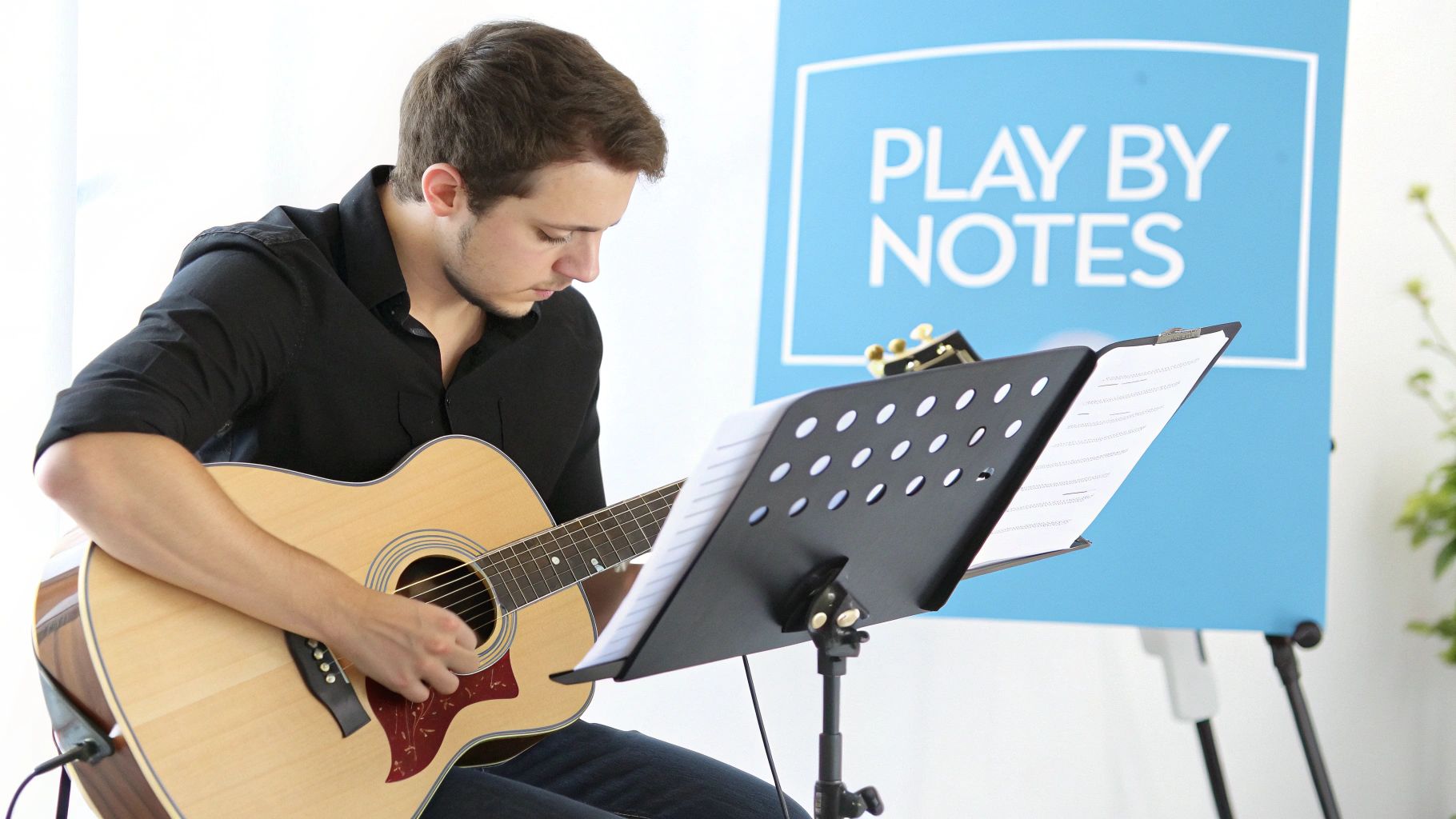
So many guitar players get their start with tablature, or "tabs." It’s a great system that shows you exactly which string and fret to hit, and it’s perfect for learning a new song fast. But here's the thing: relying only on tabs is kind of like using a GPS for every single drive you take. You’ll get where you’re going, sure, but you never really learn how to read a map or understand the layout of the land. You're just following a set of instructions.
Learning to read standard musical notation, on the other hand, is like becoming fluent in a global language. It is, without a doubt, the single biggest step you can take to go from just playing songs to truly understanding music on a deeper level.
The Freedom of Fluency
Once you can read notes, a whole new world opens up. You’re no longer stuck waiting for someone to create a tab for a song you want to learn. Instead, you gain access to centuries of music written for any instrument that uses the treble clef—from classical melodies and jazz standards to pop tunes and beyond.
This fluency gives you a common language that lets you:
- Collaborate with any musician: You can sit down with a pianist, a violinist, or a saxophone player and immediately understand what they're playing and how your part fits in.
- Deepen your theoretical knowledge: Music theory suddenly makes so much more sense when you can see the relationships between notes right there on the page.
- Play in ensembles: Joining a band or a group class, like the Guitar Group Classes at East Valley School of Music, becomes incredibly straightforward when everyone is speaking the same musical language.
The real shift happens when you stop seeing notes as abstract rules and start seeing them as direct communication. You're not just playing a song; you're interpreting the composer's intent, from the precise pitch to the exact rhythmic feel.
Bridging a Common Skill Gap
The guitar is one of the most popular instruments on the planet—some estimates suggest 10% of the world's population can play it. But there’s a strange gap in how it's often taught. A survey of guitar classes in the U.S. revealed that only 57% of teachers include standard notation in their curriculum. That’s a huge contrast to band and orchestra programs, where reading music is day-one fundamental.
This creates a skill gap that holds many guitarists back. Learning to play by notes empowers you to close that gap and become a far more capable and well-rounded musician. You can learn more about the state of guitar education from various industry resources.
Whether you’re just starting out or you’re an adult picking the guitar back up, this guide is here to demystify the process. We’ll show you that learning to read music isn’t about memorizing a bunch of dry rules. It’s about unlocking the door to limitless musical expression and making your journey more rewarding from the very first note you play.
Breaking Down the Language of Sheet Music
Staring at a page of sheet music for the first time can feel like trying to read a foreign language. But trust me, it’s not as intimidating as it looks. Think of it less like a language and more like a detailed map—a set of instructions telling you exactly what to play and when.
The foundation of this whole system is the staff (sometimes called a stave). It's just five simple horizontal lines with four spaces in between. Each line and each space represents a different musical pitch. The rule is simple: the higher a note is placed on the staff, the higher it sounds.
The Treble Clef: Your Guitarist's Compass
Those lines and spaces are meaningless on their own until you have a reference point. That's where the treble clef comes in. As a guitarist, this is the main symbol you'll see at the start of every line of music. It’s that fancy, curly symbol that kind of looks like a stylized “G.”
That G-like shape is no accident. The inner curl of the clef wraps perfectly around the second line from the bottom, and that’s its whole job: it permanently locks that line in as the note G. Once you know where G is, you can find any other note just by counting up or down the musical alphabet (A, B, C, D, E, F, G).
Mnemonics: The Musician's Secret Weapon
To speed things up, musicians have used simple memory tricks, or mnemonics, for centuries. They’re a lifesaver when you’re starting out.
For the notes on the five lines of the staff (from the bottom up), the classic phrase is:
- Every
- Good
- Boy
- Deserves
- Fudge
And for the notes in the four spaces (again, from the bottom up), it’s even easier because they spell out a word:
- F
- A
- C
- E
Seriously, commit these two phrases to memory. They're the foundation for everything that follows. It's the difference between guessing and knowing, and that's what makes a real musician.
Here’s a quick reference table I give all my students to help lock this in.
Quick Reference for Notes on the Treble Clef
Use this guide to quickly identify the names of the notes on the lines and in the spaces of the treble clef staff.
| Location | Mnemonic | Note Names |
|---|---|---|
| Lines (bottom to top) | Every Good Boy Deserves Fudge | E, G, B, D, F |
| Spaces (bottom to top) | F–A–C–E | F, A, C, E |
Once you’ve got these memorized, you'll start seeing note names instead of just dots on a page.
What Is a Note, Anyway?
Now that we know where the pitches are, let's look at the symbols themselves. The notes are the dots and lines sitting on the staff, and their design tells you two critical things: pitch (which line or space they’re on) and duration (how long to let the sound ring out).
Every note has a few basic parts.
- The Note Head: This is the oval part. Where it sits on the staff tells you the pitch (is it G, A, B?). Whether it's hollow or filled in helps determine how long you hold it.
- The Stem: This is the thin vertical line attached to the note head. Stems can point up or down, but don't let that throw you—it’s just a way to keep the music looking clean and doesn't change the note at all.
- The Flag: This is the little curvy tail you see on some stems. Flags are super important for rhythm, as they signal shorter note durations. We'll get into that in the next section.
Getting a handle on the staff, the clef, and the parts of a note is the biggest first step. You're no longer looking at abstract symbols; you're starting to read the instructions that will soon become music under your fingertips. Now, let’s connect this language directly to your fretboard.
Connecting Notes to Your Guitar Fretboard
Alright, this is where the magic happens. We're about to turn those abstract dots and lines on the page into actual music coming from your guitar. It’s all about bridging that gap between theory and practice—taking what you now know about the musical staff and making your fingers play the right note. The goal is to build a mental map that instantly connects a note you see to a specific spot on the fretboard.
A common rookie mistake is trying to memorize the entire neck at once. It's a surefire path to frustration. Instead, we're going to focus on mastering the first position. This is the most valuable real estate on your fretboard for a beginner, covering your open strings and the first four frets. Pretty much every simple melody you'll learn at first lives right here.
The whole process boils down to this: you see a note on the staff, you name it (like 'E' or 'F'), and you know exactly where to put your finger to play that 'E' or 'F'. The image below really simplifies the core elements we've just covered.
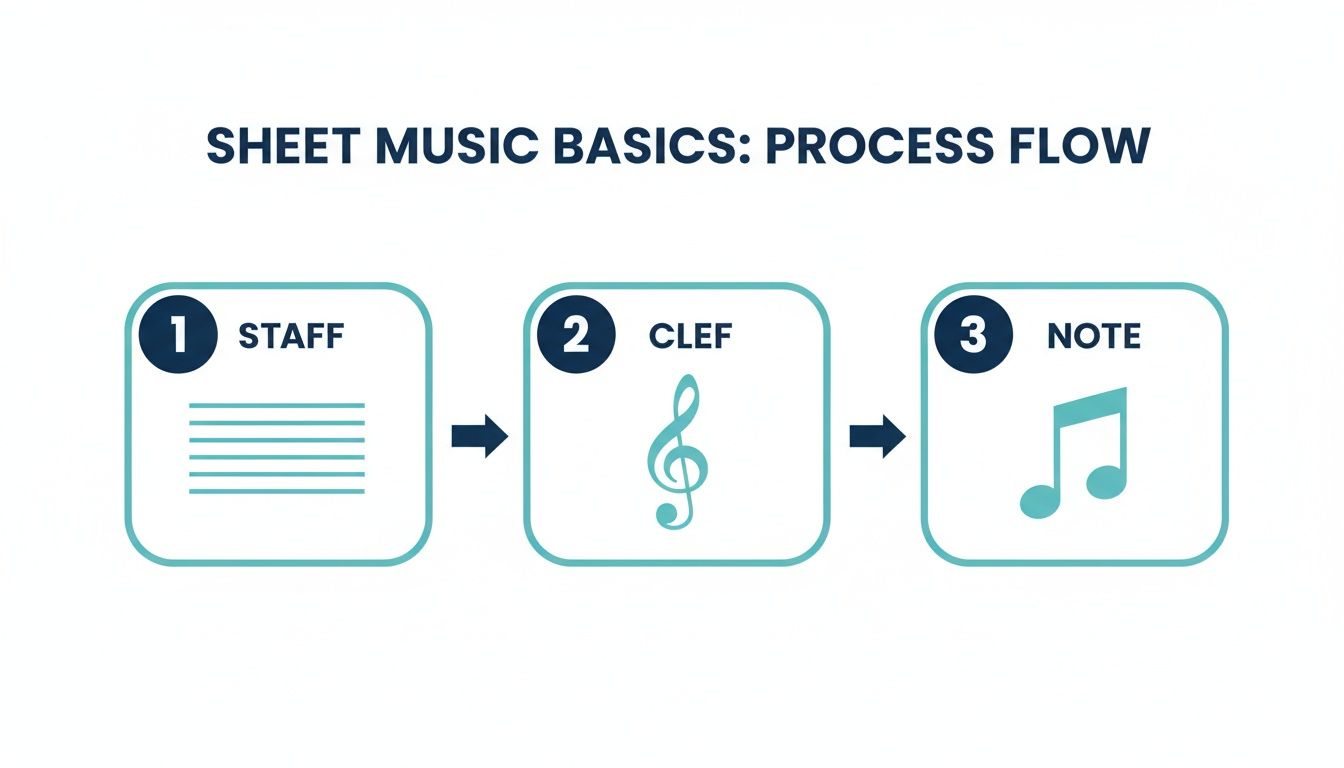
This little sequence—staff, clef, note—is the mental pathway you'll use every single time you read music. Before you know it, it'll feel completely automatic.
Starting with Your Open Strings
Think of your six open strings as the major landmarks on your fretboard map. They are your anchors. You absolutely have to memorize them from the thickest, lowest-sounding string to the thinnest, highest-sounding one: E – A – D – G – B – E.
If you need a hand remembering that, a classic mnemonic is Eddie Ate Dynamite, Good Bye Eddie!
Once those are locked in, you can start spotting them on the staff. For example, the low E sits on a ledger line just below the staff, while the high E lives in the top space. Just knowing these six reference points gives you a massive head start.
Finding Your First Fretted Notes
Now that you have your open strings as a home base, finding the fretted notes is surprisingly logical. The golden rule is simple: moving up one fret raises the pitch by one half step. Using this, you can systematically uncover every note in the first position without any guesswork.
Let’s take the 6th string (low E) to see how this works:
- Open 6th string: That’s E.
- 1st fret, 6th string: One half step up from E is F.
- 2nd fret, 6th string: Next is F# (F-sharp).
- 3rd fret, 6th string: And then we have G, which is the very same G you see on the second line of the staff.
You can apply this exact same logic to every other string. Take the open A string (5th string). The 1st fret gives you A# (A-sharp), the 2nd fret is B, and the 3rd fret is C. Just like that, you've found your first C note!
Key Takeaway: Don't fall into the trap of just memorizing fret numbers. Focus on understanding the relationship between the open string and the notes that follow it up the fretboard. This systematic approach builds a durable mental map that is absolutely essential for learning to play guitar by notes.
With a recent boom of 16 million new players picking up the instrument, a structured learning path is more important than ever. In fact, 1.6 million Americans started lessons after 2020. For these new learners, especially the 50% who are under 24, having a clear system to map the fretboard is what separates steady progress from frustrating plateaus.
A Practical Exercise for Building Your Fretboard Map
Let’s put this all into practice with a simple, repeatable exercise. We'll focus on just the first three notes of the C Major scale: C, D, and E.
- Find C: Go to the 5th string (the A string) and press down on the 3rd fret. That's your C. Play it a few times and say the word "C" out loud.
- Find D: Now, move to the 4th string (the D string). Just play this string open. That's D. Again, play it and say "D."
- Find E: Staying on that 4th string, press down on the 2nd fret. This is E. Play it and say its name.
Now, play them in order: C (5th string, 3rd fret), D (4th string, open), E (4th string, 2nd fret). This little routine does so much more than teach you three notes. It trains your brain, eyes, and fingers to work in sync, connecting the symbol on the page to a physical action on the guitar. If you're just getting started, particularly with an acoustic or classical guitar, our guide on starting your first classical guitar lessons can provide more helpful tips.
Keep repeating this process for all the notes in the C Major scale (C, D, E, F, G, A, B) within that first position. This is the bedrock of confident sight-reading, and it’s worlds more effective than trying to swallow the whole thing at once.
4. Feeling the Beat with Rhythm and Timing
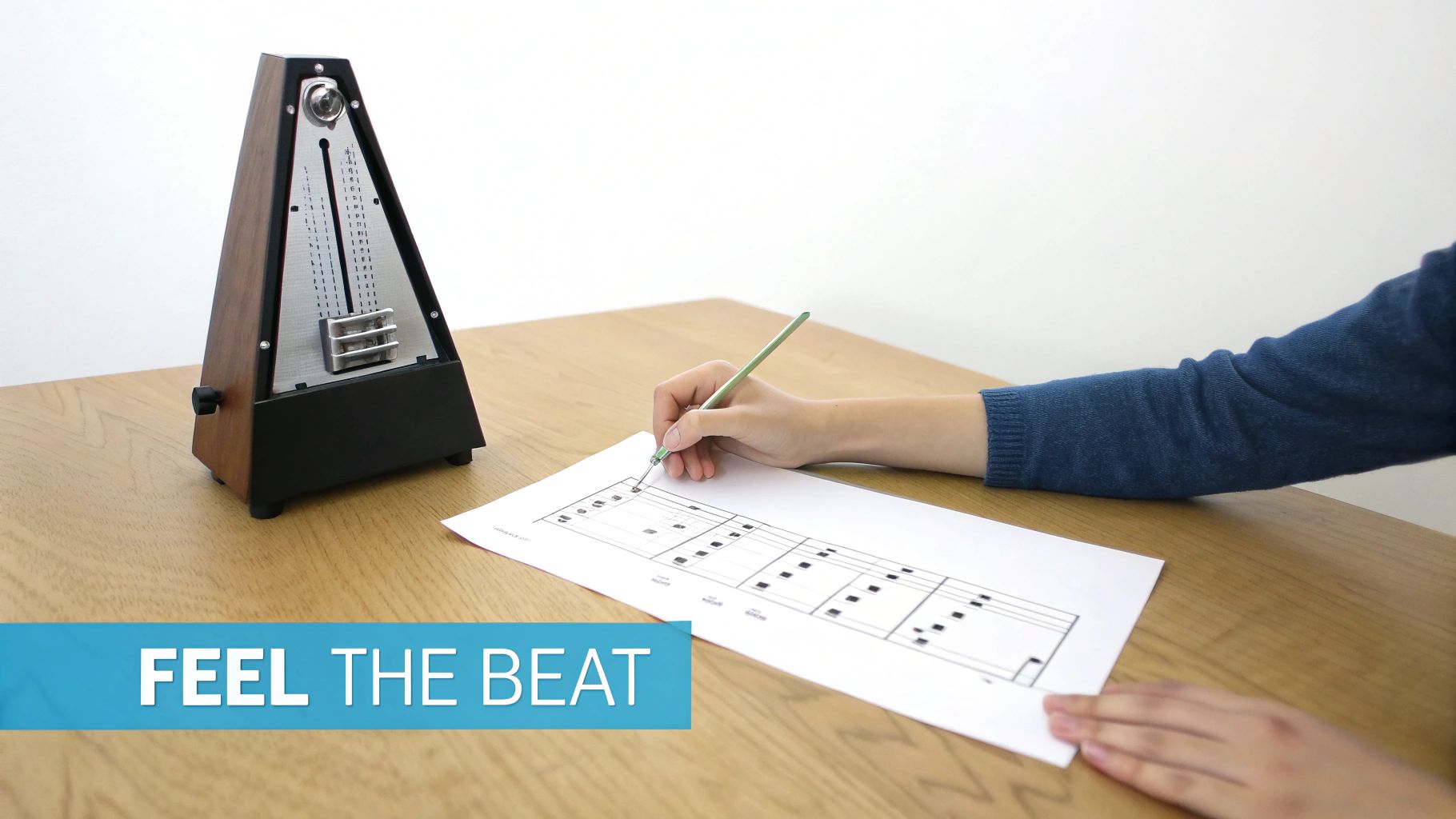
So, you're starting to find your way around the fretboard. That's a huge win. But finding the right notes is only half the battle. The notes tell you what to play; rhythm is what tells you when to play them and for how long.
Without a good sense of rhythm, even the most beautiful melody can sound robotic and disconnected. Rhythm is what breathes life into the music, turning a simple string of pitches into something that makes you want to tap your foot. Getting a handle on rhythmic notation is what will truly elevate your playing.
Understanding Note Values
Let’s keep this simple. Think of a measure of music as a whole pizza.
A whole note is the entire pizza—it lasts for all the beats in that measure. If you slice it in half, you get two half notes. Slice it again, and you’ve got four quarter notes. Each note value is just a simple division of the one before it.
- Whole Note: The longest standard note, typically lasting for four beats.
- Half Note: Lasts for half the time of a whole note, usually two beats.
- Quarter Note: This is your foundation. It lasts for one full beat, the kind of pulse you'd naturally tap your foot to.
- Eighth Note: Lasts for half a beat. You can fit two of these into the time it takes to play a single quarter note.
Of course, music isn't just about sound; it's also about the silence between the sounds. For every note value, there's a matching rest that tells you to be quiet for that exact same amount of time. Learning to feel the space is just as important as playing the notes themselves.
To help you visualize this, here’s a quick breakdown of the most common notes and rests you'll encounter, especially when you're just starting out.
Common Note and Rest Values in 4/4 Time
| Symbol | Name | Beats in 4/4 Time |
|---|---|---|
| 𝅝 | Whole Note | 4 beats |
| 𝅗𝅥 | Half Note | 2 beats |
| ♩ | Quarter Note | 1 beat |
| ♪ | Eighth Note | ½ beat |
| 𝄻 | Whole Rest | 4 beats |
| 𝄼 | Half Rest | 2 beats |
| 𝄽 | Quarter Rest | 1 beat |
| 𝄾 | Eighth Rest | ½ beat |
Getting familiar with these symbols is your first step to decoding rhythm on the page. You'll quickly start to recognize them as the building blocks of every song you learn.
What the Numbers Mean in Time Signatures
At the start of every piece of music, right after the clef, you’ll see two numbers stacked on top of each other. This isn't complicated math; it's the time signature, and it's basically the rhythmic road map for the song.
The most common one you'll see by far is 4/4, often called "common time." It's so common, in fact, that sometimes you'll just see a big "C" instead of the numbers.
Here’s what it means:
- The Top Number (4): Tells you how many beats are in each measure. In 4/4 time, you'll count "one, two, three, four" over and over again for every bar of music.
- The Bottom Number (4): Tells you which kind of note gets one beat. The "4" stands for a quarter note.
So, put it together: 4/4 means four beats per measure, and the quarter note gets one beat. Simple as that.
Learning to count is non-negotiable. You have to internalize the pulse. Before you even touch your guitar, try looking at a line of music and just clapping the rhythm while counting out loud: "1, 2, 3, 4." This physical connection is crucial for developing your internal clock.
Once you get this, you can decode any rhythm. If you're in 4/4 and see a measure with one half note and two quarter notes, you’ll know it adds up perfectly: 2 beats (for the half note) + 1 beat + 1 beat = 4 total beats.
Your Most Important Practice Tool
There's one piece of gear that every musician, from absolute beginners to world-touring pros, should have: a metronome. There's simply no better way to develop a rock-solid sense of time.
Practicing with a metronome gives you an unwavering, objective pulse that keeps you honest. It won't speed up or slow down with you, forcing your playing to become precise.
Start slow. I mean, painfully slow. Set it to something like 50 or 60 beats per minute (BPM). The goal here isn't speed; it's accuracy. As you play through rhythm exercises or a simple melody, your only job is to make every note land perfectly on the click.
At first, it will probably feel stiff and a little frustrating. But stick with it. Consistent metronome practice builds an internal sense of timing that eventually becomes second nature. This skill is the foundation for everything you'll ever want to do in music, whether you're playing alone in your room or locking in tight with a band on stage. Don't skip this.
Playing Your First Songs and Building a Practice Habit
Alright, this is where the magic happens. You’ve put in the work to understand the staff, find your notes on the fretboard, and even count out some rhythms. Now, let’s turn those abstract skills into actual music. This is the moment it all starts to click and feel real.
The best way to begin is with a song you already know by heart. Think "Twinkle, Twinkle, Little Star" or "Mary Had a Little Lamb." Why? Because your ear already knows the melody, which frees up your brain to focus completely on the new task: reading the notes on the page and telling your fingers where to go.
A Practical Approach to Learning a New Song
Staring at a fresh page of sheet music can be intimidating. Don't let it be. The key is to break it down into manageable chunks instead of trying to conquer the whole thing at once. Isolate each part of the musical puzzle before putting them together.
Step 1: Just the Pitches
Before you even touch your guitar, just look at the music. Go through the first few bars and say the note names out loud: "G, G, D, D, E, E, D…" Do this a few times. You're building a quick, solid connection between the symbol on the page and its name.
Step 2: Just the Rhythm
Now, forget about the note names entirely. Look at the same line of music and just focus on the timing. Clap the rhythm, tap it on your leg, or use a single muted string on your guitar. Count the beats out loud as you do it. This helps you internalize the song's pulse without worrying about frets and strings.
Step 3: Put It All Together, Slowly
Okay, now you can pick up the guitar. Play the piece, but do it painfully slow. The goal here is 100% accuracy, not speed. Speed is a byproduct of accuracy, and it will come naturally later. For now, just focus on playing the right note with the right timing.
The single biggest mistake I see beginners make is trying to play a new piece at full speed right away. All that does is train your fingers to make mistakes. Slow, deliberate, and accurate practice is what builds reliable muscle memory—the foundation of all fluid playing.
Crafting a Daily Practice Habit That Actually Works
When it comes to learning an instrument, consistency beats intensity every single time. A focused 20-minute session every day is infinitely more powerful than a frantic two-hour cram session on the weekend. Your brain and fingers need that regular, repeated exposure to build strong neural pathways.
A good practice routine isn't about random noodling; it has a clear structure. A plan ensures you’re covering all the bases and developing the skills you need to read music fluently.
Your Daily 20-Minute Practice Plan:
- Warm-up (3 minutes): Grab your guitar and do some simple finger exercises. A slow, one-string chromatic scale (playing every fret up and down) is perfect. Focus on clean notes and keeping your hand relaxed.
- Note Drills (5 minutes): Use flashcards or a note-reading app. Drill yourself on identifying notes on the staff. The quicker you can name them, the quicker you'll find them on the fretboard.
- Rhythm Clapping (5 minutes): Open a music book to a random page. Set a metronome to a slow tempo, like 60 BPM, and just clap or tap the rhythm of one line of music. This is like weight training for your internal clock.
- Song Work (7 minutes): Now, focus on the song you're learning. Don't try to play the whole thing. Just tackle one or two measures using the three-step method above until that small section feels solid and accurate.
This balanced approach ensures you’re not just memorizing songs, but actively building the fundamental skills of a true musician.
Making Your Practice Time Count
Recent studies show a fascinating trend: 16 million people in the U.S. have started playing guitar in the last few years. According to Fender's new guitar player landscape analysis, 53% of these new players practice for about two hours a week. A structured routine like the one above makes sure every minute of that time pushes you forward.
This is where a great teacher becomes your most valuable asset. They don't just show you what to practice; they teach you how to practice for maximum results. An instructor can help you set achievable goals, spot bad habits before they take root, and build a sustainable routine that leads to real progress. This kind of expert guidance is central to what we do, and you can see how we put it into action in our guitar lessons for beginners. Building that solid practice habit from day one is the most reliable way to become the musician you want to be.
Got Questions About Learning Guitar by Note? Let's Clear Things Up.
As you start digging into reading music on the guitar, it's totally normal for questions to pop up. This can feel like a big undertaking, and running into a few mental roadblocks is part of the process. Let's walk through some of the most common questions I hear from students just starting out.
Getting these initial hurdles out of the way is huge for building confidence. Just remember, every great musician was once a beginner, fumbling through the exact same stuff you are now.
Is Reading Notes Actually Harder Than Using Tabs?
Okay, let's be real: at first glance, tabs look way easier. They’re a direct map—string number, fret number, done. You can learn a specific part of a song very quickly with them, and that’s awesome.
But here's the catch: relying only on tabs is like using a GPS for every single drive you ever take. You get to your destination, but you never actually learn the roads. Learning to read standard notation is like learning to read the map itself. It gives you the power to go anywhere you want, not just follow a pre-planned route.
Once you can read notes, you're not just playing a song; you're understanding the language of music. You can talk and play with a piano player, a saxophonist, or a singer, and you'll all be speaking the same language. It’s an investment that pays off for your entire musical life.
So, How Long Does It Take to Get Good at This?
This is the big one, and the honest answer really comes down to how consistently you practice. Everyone learns at a different pace, but if you can put in a focused 20-30 minutes a day, you'll likely start feeling comfortable with simple melodies in the first position in about three to six months.
Getting truly fluent—the kind of fluent where you can pick up a new piece of music and just play it (that's sight-reading!)—takes longer. You're probably looking at a year or more of steady work. But the journey is full of small wins that keep you going.
It’s not about how many hours you cram in on a Saturday. The real magic comes from consistent, daily effort. A little bit of focused practice every single day will beat a long, sporadic session every time.
Having a structured path, like you'd get in lessons, can really speed things up. A good teacher knows how to make your practice time count, so you’re always working on the right thing at the right time.
Do I Really Need a Teacher to Learn to Read Music?
You can teach yourself to read music—plenty of people have. But a good teacher is a shortcut that helps you avoid years of frustration and bad habits. They provide instant, personalized feedback that you just can't get from an app or a book.
Think of a teacher as your guide. Their job is to:
- Stop Bad Habits Before They Start: They'll spot if your hand position is a little off or your posture is working against you, fixing it before it becomes a problem you have to un-learn later.
- Make Sense of the Confusion: When a concept just isn't clicking, a teacher can explain it five different ways until one finally makes sense for you.
- Keep You Going: A great instructor knows when to push you and how to help you get through those inevitable plateaus where you feel completely stuck.
Ultimately, learning with a teacher is the difference between trying to find your way through a dense forest with a compass versus having an expert guide show you the clearest path. If you want to know more about what goes on in a lesson, check out our article on what a guitar teacher wants you to know.
What Are the Best Exercises for Practicing Sight-Reading?
Start simple. Your goal at the beginning is accuracy, not speed. Speed will come later on its own.
Set a metronome to a painfully slow tempo—I’m talking 50 or 60 BPM—and just play single-note lines in the first position (frets 1-4). The most important part of the exercise is to play through a short piece without stopping, even if you flub a note. You're training your eyes to keep moving forward on the page while your brain sends the right signals to your fingers.
Here’s another great trick: say the note names out loud as you play them. It feels a little silly at first, but it powerfully connects what you see, what you say, and what you do on the fretboard. Most beginner guitar method books are packed with simple exercises designed to build these foundational skills one step at a time.