
Guitar major and minor scales are the language of music.Think of guitar scales as the alphabet of music. Just as letters combine to form words, the notes within these scales are the raw material for the chords and melodies that make up your favorite songs. They aren't just tedious drills; they're roadmaps that guide you across the fretboard, showing you exactly which notes will work together.
The real magic behind major and minor scales is their distinct emotional character, which all comes down to a specific sequence of intervals—the distance between the notes. This simple formula of whole steps (a two-fret jump) and half steps (a one-fret jump) is what gives each scale its signature sound.
- Major Scales create an uplifting, cheerful, and resolved feeling. They are the backbone of most pop, rock, and country music.
- Minor Scales produce a sad, mysterious, or tense mood. This makes them perfect for blues, metal, and emotionally charged ballads.
Understanding the Formulas
The major scale follows a specific pattern of steps: whole-whole-half-whole-whole-whole-half (W-W-H-W-W-W-H). This formula is so fundamental that its origins can be traced back over 2,500 years to Ancient Greece. Its timeless appeal is undeniable; studies in computational musicology have shown that major scales are present in about 65% of all Billboard Hot 100 hits from the last 70 years.
On the other hand, the natural minor scale uses a different formula: whole-half-whole-whole-half-whole-whole (W-H-W-W-H-W-W). By simply lowering the 3rd, 6th, and 7th notes of a major scale, you instantly create its relative minor and unlock an entirely new emotional palette.
To see these differences side-by-side, here’s a quick breakdown:
Major vs. Minor Scale at a Glance
| Characteristic | Major Scale | Natural Minor Scale |
|---|---|---|
| Interval Formula | 1, 2, 3, 4, 5, 6, 7 | 1, 2, b3, 4, 5, b6, b7 |
| Step Pattern | W-W-H-W-W-W-H | W-H-W-W-H-W-W |
| Common Feeling | Bright, Happy, Uplifting | Sad, Somber, Dramatic |
| Musical Examples | "Happy Birthday," Pop Anthems | "Losing My Religion" by R.E.M., Blues Licks |
This table illustrates how just a few small changes in the note formula can completely alter the mood of the music you create.
Here’s the real secret: You don't need to memorize dozens of scales to get started. By learning just one major and one minor scale pattern, you can play in any key imaginable just by moving that shape to a different starting note, or root note, on the fretboard.
Mastering these foundational patterns is a total game-changer. It builds crucial muscle memory in your fretting hand, trains your ear to recognize what sounds right, and gives you the confidence to start improvising your own licks and solos.
If you’re looking for a structured environment to build these skills, exploring our group guitar classes can provide expert guidance and a supportive community. For now, this guide will walk you through the practical shapes and exercises to get you playing scales with confidence.
Getting Your First Scale Shapes Under Your Fingers
Theory is one thing, but getting that knowledge onto the fretboard is where the magic happens. Don't fall into the trap of trying to learn a dozen confusing patterns at once. To build a rock-solid foundation, we're going to zero in on just two essential, movable shapes: one for major scales and one for minor scales.
Think of these shapes as your keys to unlocking the entire neck. Once you learn a single pattern for each, you can play in any key you want just by sliding that shape to a new starting fret. It's a ridiculously practical way to build muscle memory without getting overwhelmed.
The Movable Major Scale Shape
Let's start with a major scale shape rooted on the 6th string (your thickest E string). This pattern is a guitarist's bread and butter, a true workhorse. We'll use G Major for our example, so our starting note—the root—will be on the 3rd fret of the low E string.
Here's how to tackle this shape to get the most out of it:
- One Finger Per Fret: This is a golden rule. Assign your index finger to the lowest fret in the pattern, your middle to the next, your ring to the next, and your pinky to the last one. This keeps your hand relaxed and efficient.
- Start on the Root: Always begin and end your practice on the root note (G, in this case). This trains your ear to recognize the "home base" sound of the scale.
- Say the Notes Out Loud: As you play each note, actually say its name. It feels a bit silly at first, but this trick forges a powerful link between the physical shape, the sound, and the theory.
For instance, when starting on G (3rd fret, low E), you'd use your middle finger. For the next note, A (5th fret), you'd stretch your pinky. Sticking to this kind of disciplined fingering from the start is what builds clean, reliable technique. If you're new to this, getting feedback through structured guitar lessons for beginners can make a huge difference in avoiding bad habits.
Pro Tip: Once that G Major shape feels comfortable, just slide the whole thing up two frets. Your root note is now on the 5th fret, which is A. And just like that, you're playing the A Major scale using the exact same finger movements. That's the power of movable shapes in action.
The Essential Minor Scale Shape
Alright, time for the minor scale. To give you more options across the neck, we'll learn a pattern rooted on the 5th string (the A string). Let's use B minor, which kicks off on the 2nd fret of the A string.
This pattern will feel a little different under your fingers, but the core principles are the same. Anchor your hand, stay consistent, and focus on clean notes.
Here’s a great way to drill this one into your muscle memory:
- Find Your Root: First, locate B on the 2nd fret of the A string. That’s your home base.
- Go Slow: Set a metronome to a painfully slow tempo, like 60 BPM. The goal isn't speed; it's clarity. Make every single note ring out perfectly, with no buzzing.
- Alternate Pick Everything: Use strict down-up-down-up picking for every note. This is non-negotiable if you want to build speed and rhythmic precision later on.
By truly mastering these two shapes—one major and one minor—you're building a reliable framework for navigating guitar major and minor scales in pretty much any song. Practice them until they feel automatic. You're not just memorizing patterns; you're internalizing the sound and feel of music itself.
Connecting the Dots with the CAGED System
So, you've started learning some scale shapes. That's a huge step forward. But the real "aha!" moment happens when you stop seeing them as isolated boxes and start understanding them as interconnected pieces of one giant puzzle.
This is exactly what the CAGED system is for. Think of it as a GPS for your fretboard. It’s a brilliant method that uses the five open chord shapes you probably already know—C, A, G, E, and D—to map out the entire neck. The core concept is that these familiar chord voicings double as movable scale patterns that link up seamlessly, freeing you from being stuck in one spot.
How CAGED Unlocks the Fretboard
The magic of the system is how the end of one shape literally becomes the start of the next one. For example, if you're playing a scale using the C-shape pattern, the notes at the top of that pattern blend right into the bottom notes of the A-shape pattern. That A-shape then flows into the G-shape, which leads to the E-shape, and then the D-shape. Before you know it, you’re back at another C-shape, just an octave higher.
It's this chain reaction that changes everything. Instead of thinking, "Okay, I'm playing the G major scale in the 5th position box," you start to see the entire G major scale as a continuous road that winds through these five related shapes. This is precisely how seasoned players seem to glide effortlessly up and down the neck during a solo.
The CAGED system isn't about memorizing five more patterns. It's a mental framework for understanding the internal logic of the fretboard. It shows you exactly how the notes of any key are laid out across every string and every fret.
This visual map helps illustrate the basic relationship between a root note and the major and minor scale shapes built from it.
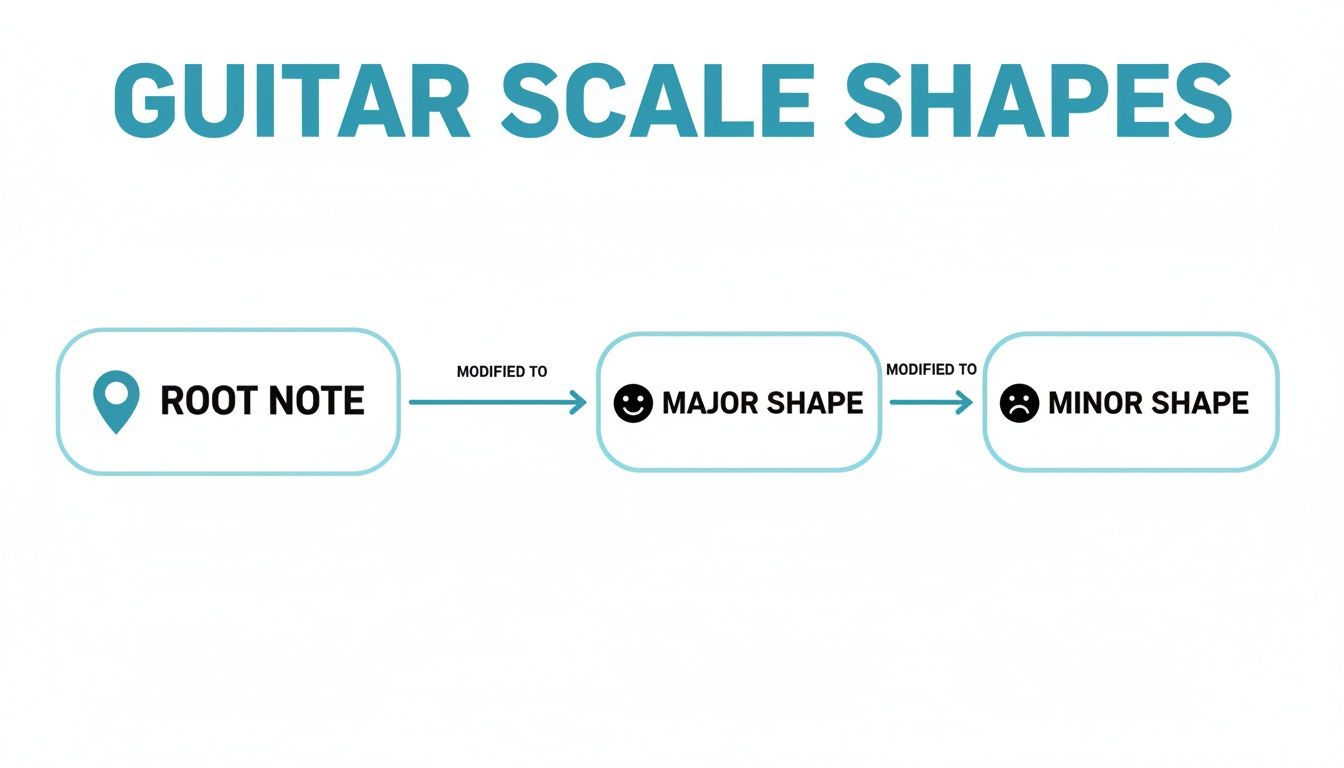
As the flowchart shows, both "happy" sounding major scales and "sad" sounding minor scales come from the same starting root note—the only difference is the formula of intervals used to build them.
Putting the System into Practice
Let's ground this in a real-world example. Say you’re jamming in G major and playing a lick using the E-shape pattern, which starts down on the 3rd fret. As you move up through that scale, you'll find the highest notes are hanging out around the 5th and 7th frets. Well, guess what? The D-shape pattern for G major starts right there, using those very same notes as its launching point. See how they connect?
To start getting this under your fingers, try these steps:
- Master the Movable Chords First: Before you even think about scales, get comfortable playing C, A, G, E, and D as barre chords all over the neck. This builds the muscle memory for the shapes themselves.
- Find Your Roots: Pick one key, like C major, and find the root note 'C' inside each of the five CAGED shapes. Go all the way up the fretboard. These root notes are your signposts for each pattern.
- Connect Just Two Shapes: Don't overwhelm yourself by trying to link all five at once. Work on moving smoothly between just two adjacent shapes, like the G-shape and the E-shape, over and over until it feels completely natural.
Adopting this way of thinking completely transforms your relationship with guitar major and minor scales. You move from rote memorization to true visualization. With a little time, those five separate boxes will merge into a single, fluid scale that covers the entire fretboard, unlocking a new level of creative freedom for your solos.
Adding Emotion with Different Minor Scales
The natural minor scale is fantastic for those somber, melancholic moods, but it's just one color in a massive emotional spectrum. The world of guitar major and minor scales is way more nuanced than just "happy" and "sad." By changing just one or two notes in the natural minor, you unlock two incredibly powerful variations: the harmonic minor and the melodic minor.
These aren't just dry theory exercises. Think of them as essential tools for dialing in specific kinds of tension, drama, and sophistication into your playing. Each one has its own distinct personality and really shines in different musical situations.
The Dramatic Tension of the Harmonic Minor
The harmonic minor scale is pure drama. It’s that dark, exotic, and intense sound you hear in neoclassical metal and fiery classical pieces. To build it, you just take a natural minor scale and raise the 7th note by a half-step (which is just one fret on the guitar).
Let’s start with A natural minor as our reference: A – B – C – D – E – F – G.
To get the A harmonic minor, we simply sharpen that G to a G#: A – B – C – D – E – F – G#.
That single change creates a big, dissonant-sounding jump between the 6th note (F) and that newly raised 7th (G#). This specific interval is what gives the scale its instantly recognizable, tense character.
The minor scale family, with its natural, harmonic, and melodic forms, has a history that stretches all the way back to ancient Greek modes around 150 CE. Fast forward to the 1980s, and players like Yngwie Malmsteen put this scale on the map for guitarists, famously using the harmonic minor in roughly 70% of his neoclassical solos. Its legacy is undeniable, with 42% of 10,000 Guitar World readers calling it an essential scale for shredding. If you're curious, you can discover more insights about their evolution and see how these sounds developed over time.
The Smooth Sophistication of the Melodic Minor
If the harmonic minor is all about drama, the melodic minor scale is its smooth, jazzy, and sophisticated cousin. It was originally developed to smooth out that wide, somewhat awkward-sounding leap in the harmonic minor, which made it easier for vocalists to sing and created more flowing melodic lines.
The melodic minor has a really unique twist: it changes depending on whether you're going up or down the scale.
Ascending (going up): You raise both the 6th and 7th notes of the natural minor. So, for A melodic minor, it becomes: A – B – C – D – E – F# – G#. Listen to how it almost sounds like a major scale toward the end.
Descending (going down): You switch back to the plain old natural minor scale. That means you’d play: A – G – F – E – D – C – B.
Pro Tip for Guitarists: While classical and jazz purists are strict about descending with the natural minor, many modern guitar players just use the ascending form of the melodic minor for both ascending and descending lines. It creates a very cool, modern sound that works beautifully over minor-major seventh chords (min/maj7).
Getting comfortable with these minor scale variations will open up a whole new vocabulary for your solos and melodies. The real magic happens when you learn when to use each one, allowing you to paint with a much richer palette of musical colors.
How to Practice Scales for Real Progress
Knowing the shapes of guitar major and minor scales is one thing. Making them sound like music is a whole different ball game. The real journey begins when you move beyond just memorizing patterns and start building the deliberate habits that create fluid, confident playing.
It's time to stop just running up and down the fretboard. The goal isn't just to play notes—it's to play them cleanly, in time, and with purpose. These drills will help you build the accuracy and musicality to make your scales truly sing.
Build Your Foundation with Picking and Timing
Before you can even think about playing fast, you have to learn to play clean. The most fundamental technique for this is alternate picking, which is just a fancy way of saying you use a strict down-up-down-up picking motion. This simple habit creates an even attack and builds the mechanical efficiency you'll need later for speed and rhythmic control.
Your best friend on this journey? A metronome. It's an honest, and often brutal, tool that will tell you exactly where your timing is solid and where it’s falling apart.
- Start Slow: Seriously, slow. Set your metronome to a tempo where you can play a scale perfectly, even if it feels agonizingly slow. Try 60 BPM.
- Aim for Perfection: The goal here is flawless execution. Every single note needs to ring out clearly and lock right in with that click. No exceptions.
- Inch the Speed Up: Once you can nail the scale perfectly a few times in a row, nudge the tempo up by just 4-5 BPM. This gradual process is key—it builds speed without sacrificing that crucial accuracy.
Rushing ahead without a solid rhythmic foundation is the number one reason players hit a speed wall they can't seem to break. This methodical approach trains your fingers to move with precision. Developing a strong sense of time is a huge part of your growth; to dig deeper, check out our guide on how to learn to play the electric guitar the right way from the start.
Break the Mold with Musical Sequences
Let's be honest, playing a scale straight up and down is a decent warmup, but it's not exactly musical. To start thinking like a soloist, you need to break out of that linear rut by playing sequences. A sequence is just a repeating melodic idea applied to a scale.
For instance, instead of playing the notes 1-2-3-4-5-6-7-8, try playing the scale in thirds: 1-3, 2-4, 3-5, 4-6, and so on up the neck. This one simple change immediately makes the scale sound more like a real melody and less like a technical exercise.
Here are a few other popular sequences to get you started:
- Groups of Three: Play the scale in three-note chunks (e.g., C-D-E, then start on the next note, D-E-F).
- Intervals of a Fourth: Play up the scale in fourths (e.g., C-F, then D-G, E-A).
- The 1-2-3 Pattern: Play the first three notes, then start the same three-note pattern from the second note of the scale (C-D-E, D-E-F, E-F-G).
Practicing sequences like these trains your fingers to make more complex moves and, more importantly, helps your brain see new melodic possibilities hidden within the scale shapes you already know. This is how you start turning those sterile patterns into expressive musical ideas.
Common Questions About Guitar Scales
As you start digging into major and minor scales on the guitar, a few questions always seem to come up. Trust me, you're not the first person to wonder about these things! This is your go-to spot for clearing up some of that common confusion.
Getting these answers straight can be a game-changer, letting you practice with a lot more confidence and a clear sense of direction. Let's get into some of the questions I hear from students all the time.
Do I Need to Learn All the Scales at Once?
Definitely not. In fact, please don't even try. It's probably the single biggest mistake I see beginners make. Trying to cram dozens of scale patterns into your brain at once is just a recipe for burnout and feeling totally lost.
A much better way to go is to pick just one major scale shape and one minor scale shape and really master them. If you learn movable patterns, like the ones rooted on the 6th and 5th strings, you can technically already play in any key. You just slide that same shape to a different starting fret. It's all about depth over breadth; knowing two shapes like the back of your hand is way more useful than having a vague idea of twelve.
The real goal here is to get the sound and feel of major and minor into your ears and fingers, not just to collect a bunch of patterns. Once you've got a couple of shapes down cold, then you can start adding more to connect them all over the fretboard.
How Fast Should I Be Able to Play Scales?
Think of speed as a side effect of accuracy, not the main goal. It’s totally normal to want to rip through scales like your guitar heroes, but chasing speed too early just builds sloppy habits that are a pain to fix later on. Your top priority should always be cleanliness and playing in time.
Grab a metronome and find a tempo where you can play every single note perfectly. Seriously, if you can nail a scale at 60 BPM without a single mistake, your foundation is a hundred times stronger than someone who can stumble through it at 120 BPM. The speed will come on its own once your muscle memory is locked in from all that deliberate, accurate practice.
What Is a Relative Major or Minor Scale?
Ah, this is one of my favorite music theory "hacks." Every major scale has a relative minor, which is just a different scale that uses the exact same notes, but starts and ends on a different one. Take C Major (C-D-E-F-G-A-B). The notes in A minor are A-B-C-D-E-F-G. Same exact notes, different vibe.
So what does that actually mean for you on the guitar?
- It basically cuts your memorization in half. That G Major pattern you just learned? It's also the E minor pattern. All you have to do is shift your thinking so that 'E' is your new root note.
- It demystifies songwriting. You'll start seeing why a song in the key of C Major almost always has an Am chord hanging around. They're family!
Understanding this relationship is a massive shortcut. It makes the connection between keys and chords click, which makes your whole journey with guitar major and minor scales feel a lot more natural.
Ready to turn all this theory into actual music? At East Valley School of Music, we offer personalized lessons to build that solid foundation and help you hit your goals. Learn more about our guitar programs and start your journey today!