
Introduction: Why Band Auditions Matter for Student Musicians
For young musicians in Chandler and across Arizona, school band auditions are more than a placement test—they’re a checkpoint that shapes your musical growth for the year ahead. Chair placements determine the parts you’ll play, the peers you’ll sit next to, and the repertoire you’ll tackle. Strong results can open doors to advanced ensembles, leadership opportunities, and regional or All-State consideration.
Even if you’re new to preparing for music auditions, the process teaches discipline, focus, and resilience. You learn to set goals, measure progress, and perform under pressure—skills that carry over to academics and sports. With thoughtful preparation and guidance, school band auditions become less about nerves and more about showcasing the best version of your playing.
Understanding What Band Directors Look For During Auditions
Band directors use clear criteria to evaluate each player. While specifics vary by district and ensemble, most rubrics include:
- Tone quality: A centered, resonant sound that’s consistent across your range.
- Intonation: Playing in tune with a stable pitch center and quick corrections.
- Rhythm and pulse: Accurate counting, steady tempo, and clean subdivisions.
- Articulation and style: Clear tonguing or sticking, stylistic consistency, and phrasing.
- Technical facility: Fluency with scales, arpeggios, chromatic runs, and range.
- Musical expression: Dynamics, shaping, and attention to the composer’s markings.
- Sight-reading: Accurate rhythms, pitches, and dynamics on unfamiliar music.
- Professionalism: Prepared music, appropriate tempo choice, and calm stage presence.
Before you plan your band audition preparation, read your school’s audition packet thoroughly. Note the required scales (keys, ranges, and octaves), chromatic expectations, etudes or solo options, and timing rules. When you understand the target, your practice becomes focused and efficient.
Essential Scales and Technique Exercises for Audition Success
Scales are the foundation of audition success. They reveal your command of tone, finger coordination, and intonation in every key you’ll encounter during the year. Prioritize these core elements:
Major scales
- Middle school: At least six common keys (C, G, D, F, Bb, Eb) at quarter = 80–100; one or two octaves depending on instrument and range.
- High school: All 12 major scales at quarter = 100–120; two octaves where applicable.
Chromatic scale
- Aim for a comfortable full-range chromatic (instrument dependent), starting slowly (quarter = 72) and progressing to a smooth, slurred or legato-tongued execution at quarter = 120. Focus on even finger transitions and airtight slurs (winds/brass) or stick-to-stick consistency (percussion mallet instruments).
Arpeggios and thirds
- Practice tonic arpeggios for every prepared major key.
- Add broken thirds to develop independence and interval accuracy.
Technique by instrument family
- Flute/clarinet/saxophone: Long tones with crescendo–diminuendo, register transitions (e.g., chalumeau to clarion for clarinet), and articulated scale patterns (T-TK or TKTK to refine speed and clarity).
- Double reeds: Long tones with embouchure stability, interval slurs across the break, and reed-adjustment practice to center pitch.
- Brass: Lip slurs (low-to-high slur ladders), Clarke-style technical studies (for trumpet/low brass transcriptions), and articulation bursts (four- and eight-note patterns).
- Percussion—snare: Rudiments (single/double stroke rolls, paradiddles, flam taps) at slow-to-fast-to-slow cycles; dynamic contrast exercises.
- Percussion—mallets: Major scales in two mallet and four mallet formats, block chords to broken chord transitions, and interval control drills.
- Percussion—timpani: Tuning drills by ear and pitch-matching exercises with a drone.
Efficiency tips
- Use a metronome and tuner at least 50% of your technique time.
- Rotate keys daily to avoid “favorite key” bias.
- Record scales weekly to check for consistent tone and timing.
- Add articulation patterns (all slurred, all tongued, slur two–tongue two, etc.) to each scale to simulate audition demands.
Selecting the Right Audition Piece for Your Skill Level
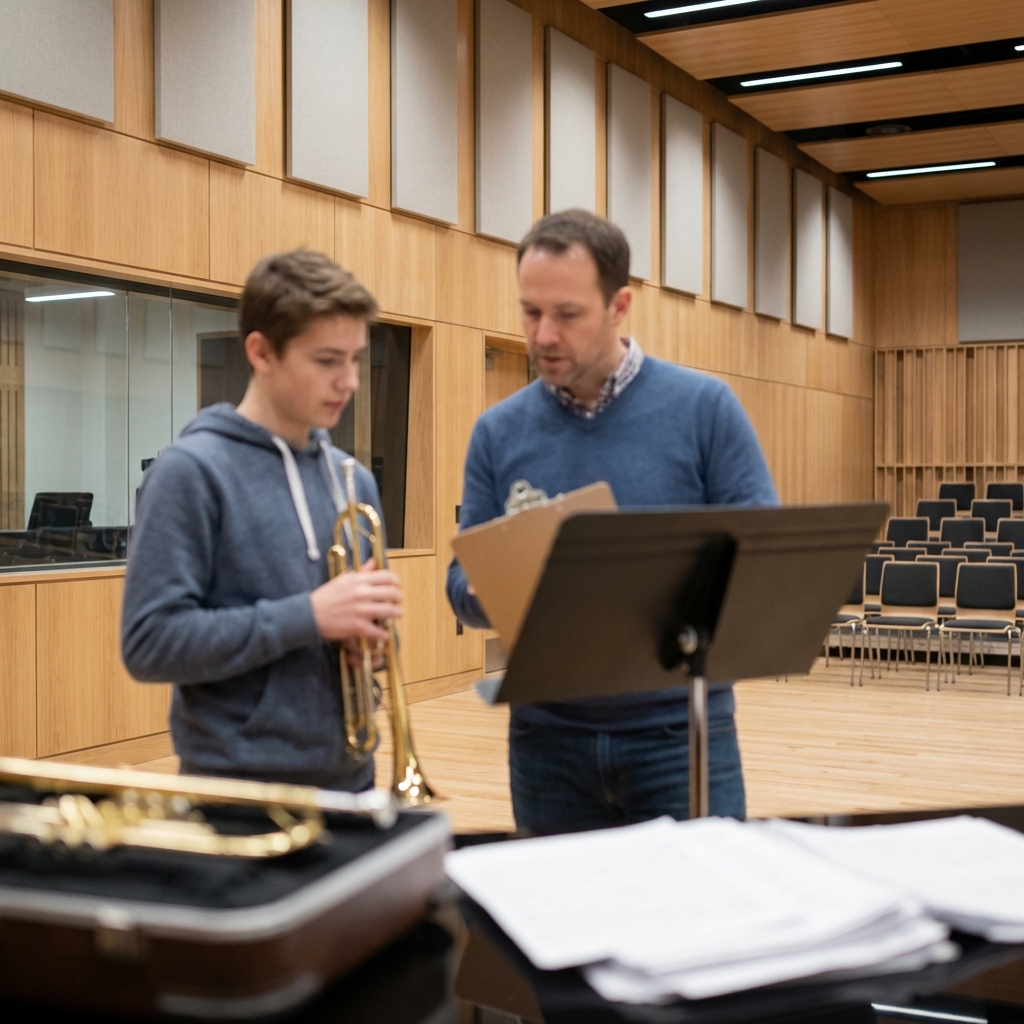
Your audition etude or solo should highlight strengths while staying within your secure technical range. Choose music you can play musically and cleanly under pressure, not just the “hardest” page you can survive.
Considerations when selecting repertoire
- Key and range: Ensure the highest/lowest notes are within your stable control.
- Rhythmic language: If compound meter or syncopation trips you up, select a piece with rhythmic patterns you can execute confidently.
- Technical features: Fast passages, leaps, trills, or multiple-stopping (mallets) should be consistent by three weeks before the audition.
- Musical contrast: A piece with dynamic, articulation, and phrasing variety lets you show expression, not just speed.
- Length and format: Confirm timing rules and whether cuts or repeats are allowed.
Reliable sources by instrument
- Woodwinds: Voxman Selected Studies, Hite Melodious and Progressive Studies (clarinet), Rubank Advanced Method etudes, Ferling 48 Etudes (oboe/saxophone rearrangements).
- Brass: Arban studies, Clarke Technical Studies (trumpet), Bordogni/Rochut Melodious Etudes (trombone/euphonium), Concone lyrical studies (horn).
- Percussion: Goldenberg Modern School for Snare Drum and Marimba; Delecluse 12 Etudes; Garwood Whaley Musical Studies.
- If your district provides specific etudes, prioritize those over outside literature.
A practical approach
- Play through two or three candidate pieces at 80% tempo.
- Score yourself on accuracy, tone, and musicality. Pick the one with the most consistent performance today—not the one you hope will click later.
- Confirm the selection with a private teacher or band director to avoid surprises.
Effective Practice Schedules: Building Confidence Before Auditions
A well-structured plan transforms nervous energy into reliable performance. Use a phased approach starting four to eight weeks out.
Eight to six weeks out
- Daily: 15–20 minutes of tone/long tones; 20 minutes of scales/chromatic; 20–30 minutes on etude/solo.
- Weekly: One recorded run-through of scales and your piece; identify two measurable goals (e.g., clean measure 17 at quarter = 88; fix intonation on high E).
Five to three weeks out
- Increase tempo gradually (2–4 bpm per day when clean).
- Alternate blocked practice (isolating measures) with interleaved practice (cycling sections A–B–C).
- Add simulated sight-reading every other day (30–60 seconds to scan, then play once).
Two weeks out
- Two mock auditions per week: play scales, then the piece, then a brief sight-reading excerpt in one take.
- Focus on consistency across attempts rather than chasing a single “perfect” run.
- Use a “red pen list”—three fixes per session only—to keep practice targeted.
Final week
- Prioritize sleep and light, high-quality reps rather than marathon sessions.
- Two full run-through days, spaced apart, at performance tempo with recording.
- Day-before: 60–75% volume, slow scales, confidence checks on starts and endings.
Session structure (45–60 minutes)
- Warm-up: 10–15 minutes (tone, slow flexibility).
- Technique: 15 minutes (scales/arpeggios/chromatic with metronome).
- Repertoire: 15–25 minutes (problem-first, then run-through).
- Cooldown: 5 minutes (quiet long tones, easy slurs).
Mental Preparation and Performance Anxiety Management
Nerves are normal. What matters is building systems to keep your focus on execution, not fear.
Practical strategies
- Breath training: 4-7-8 breathing or box breathing before and during warm-up to stabilize heart rate.
- Visualization: Spend two minutes daily “playing” the audition in your mind—walking in, setting up, hearing your best tone.
- Performance cues: Choose three simple reminders like “tall posture,” “steady air,” “sing the line.” Use them at the start of each segment.
- Self-talk swap: Replace “Don’t mess up” with “Place the fingers” or “Blow through the phrase.” Action language supports execution.
- Pressure reps: Record yourself, invite a family member to listen, or play for a small group to normalize adrenaline.
Lifestyle factors
- Sleep: Protect 8–9 hours especially in the final 72 hours before your audition.
- Hydration and nutrition: Avoid dehydrating drinks and heavy meals right before; choose light proteins and complex carbs.
- Screen time: Limit late-night scrolling to improve sleep quality and memory consolidation.

Mock Auditions: Simulating Real Performance Conditions
The closer your practice feels to the real thing, the more comfortable you’ll be when it counts. Mock auditions replicate the flow and constraints you’ll face on audition day.
How to run an effective mock audition
- Environment: Use a different room than your practice space. If possible, reserve a small hall or classroom to change acoustics.
- Timing: Follow the exact time limit for scales, etudes, and sight-reading. Keep a visible countdown timer.
- Materials: Use clean copies of your music; prepare the same stand, reeds, mallets, mutes, or valve oil you’ll bring.
- Panel: Ask your teacher, a parent, or peers to sit quietly and score you using a rubric (tone, intonation, rhythm, musicality, accuracy).
- One-take rule: No stopping. Treat mistakes as real-time recovery opportunities.
Local advantage
- In Chandler, students often have access to school spaces after hours or community rooms for full-volume run-throughs. If you need a performance setting, East Valley School of Music offers a dedicated 100-seat performance hall that’s ideal for realistic mock auditions and small studio classes. The acoustics and presence of an audience—even a small one—can increase your ability to manage adrenaline before the real audition.
Debrief method
- Write three wins and three targeted fixes immediately after each mock.
- Review the recording within 24 hours to confirm what you heard versus what’s on tape.
- Plan the next two practice sessions around the top two issues only.
Day-of Audition: Logistics, Timing, and Final Preparation
The best audition days feel routine because you’ve rehearsed every step. Plan your logistics with the same care you give your scales.
Packing checklist
- Instrument in good repair, clean mouthpiece/headjoint, and backup reeds (at least three playable) or valve oil/slide grease.
- Percussion: Snare sticks, mallet sets (soft/medium/hard), timpani gauges checked, and a small toolkit (tape, pencil, tuning key).
- Music folder with originals/copies, a pencil, and your audition instructions.
- Water bottle, light snack, and any needed ID or registration paperwork.
- Metronome and tuner for the warm-up room only (don’t bring them into the audition unless permitted).
Timing and warm-up
- Arrive 20–30 minutes early to check in and locate the warm-up area.
- Warm-up sequence (10–12 minutes): long tones, slow slurs/flexibility, one slow scale, one at tempo, and two key “trouble” measures of your piece. Avoid full run-throughs.
- Mental reset: Two deep breathing cycles, review your three performance cues, and picture a great opening attack.
Instrument readiness
- Do a quick condition check the week prior. If you need a repair or a quality rental upgrade, take care of it early. As a Milano Music instrument rental agent, East Valley School of Music can help you secure a reliable instrument or backup so equipment never undermines your work.
Professional conduct
- Greet the panel, set your stand height confidently, and take five seconds to breathe before you start each selection.
- If you make a mistake, keep going. Directors reward poise and recovery.
Common Audition Mistakes and How to Avoid Them
Knowing the pitfalls helps you sidestep them well before audition day.
Frequent issues
- Over-tempo starts: Nerves push the pace. Count two silent measures at your chosen tempo before you begin.
- Ignoring dynamics: Under-pressure playing often flattens expression. Write dynamic reminders in your part.
- Sloppy articulation: Fast tonguing or sticking without clarity costs points. Add articulation-only reps at a slower tempo.
- Inattention to rests: Players rush rests or fill them with unintended sound. Count rests aloud in practice.
- Not reading the packet: Missing scale requirements, cut guidelines, or time limits results in avoidable point losses. Highlight the key rules.
- Poor sight-reading approach: Starting too fast, not scanning for key signatures or tricky rhythms. Use a 30-second scan ritual: key, meter, accidentals, tricky rhythms, dynamics; choose a safe tempo.
- Equipment oversights: Old reeds, dry valves, loose snare strands. Build a weekly maintenance routine.
Fixes that work
- Record two short clips per day; pick one improvement goal per clip.
- Practice starts and endings in isolation; they’re your first and last impressions.
- Use mock audition timing to enforce discipline and reduce rushing.
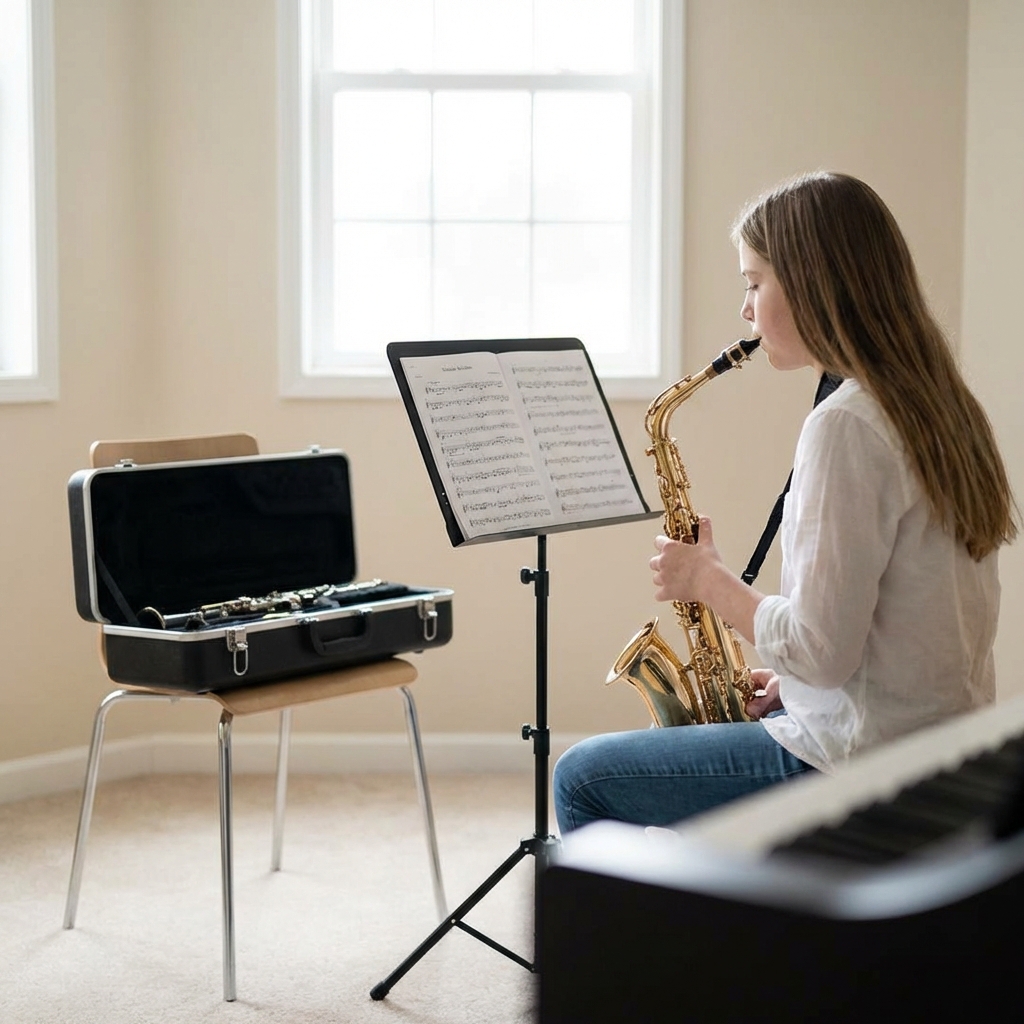
Working with Private Instructors to Perfect Your Audition
A skilled teacher shortens the learning curve by identifying the small changes that produce big results. One-on-one lessons create a customized plan for tone, technique, and musicality, and group classes build ensemble awareness that supports rhythmic precision and intonation.
What a focused audition plan includes
- Diagnostic session: Tone setup, breathing, embouchure or hand position, sticking, and posture.
- Scale matrix: A week-by-week key rotation with tempo targets and articulation patterns.
- Etude strategy: Problem-first drilling, phrasing maps, and practical tempo benchmarks.
- Sight-reading system: Daily 5-minute routine with scanning checklist and confidence tempos.
- Mock auditions: Recorded one-takes with rubric scoring and debriefs.
Families in the Chandler area often appreciate the structure and accountability that come with regular lessons, especially when audition timelines approach. If you’re seeking guidance from degree-holding instructors with school band experience, consider exploring Private lessons and the depth of expertise on Our Instructors. For eligible Arizona families, East Valley School of Music can provide documentation for ESA scholarship reimbursement requests, which helps make a comprehensive audition plan more accessible.
Beyond lessons, access to a dedicated performance hall, biannual student recitals, and collaborative group dynamic classes offers multiple low-stakes stages before the high-stakes audition—ideal for transforming anxiety into consistent performance.
Success Stories: Local Musicians Who Mastered Their Auditions
Real progress often comes from targeted changes, not wholesale overhauls. Here are representative Chandler-area stories that highlight strategies you can adapt.
Middle school clarinetist: From rushed to refined
- Challenge: Strong fingers but rushed tempos and missed dynamics.
- Approach: Switched to a “tempo pledge” 10 bpm slower than max, added a dynamics-only pass each day, and recorded two 30-second clips after dinner.
- Result: Earned first chair in her grade-level band. She reported feeling calmer because her starts and endings were automatic from daily isolation practice.
High school percussionist: Building a consistent toolkit
- Challenge: Snare etude clean, but mallet tuning and timpani pitch confidence lagged.
- Approach: Three-day rotation—snare focus, mallet focus, timpani focus—with short “maintenance touches” on the other two each day. Added drone-based mallet scale practice and daily timpani pitch-matching with a tuner drone.
- Result: Placed into an advanced ensemble and later earned a principal part on a concert piece with exposed mallet passages.
Trumpet player: Managing nerves without losing sound
- Challenge: Sound thinned during high-register passages under pressure.
- Approach: Breath work added to every session; “sustain the line” cue taped to the stand; final-week rehearsals at 80% volume to reduce fatigue. Mock auditions in a small hall to simulate adrenaline.
- Result: Delivered a centered tone throughout the audition and moved up multiple chairs, crediting the breathing routine and performance cues for keeping focus.
Across all three, the common thread was structure: specific goals, realistic tempos, and frequent run-throughs in performance-like conditions.
Conclusion: Your Path to Band Audition Excellence
Success at school band auditions starts with clarity—know the rubric, the required scales, and the time limits. Build a plan that combines daily technique, deliberate slow practice, and frequent mock performances. Treat mental preparation with the same seriousness as your fingerings and sticks, and engineer your day-of logistics so nothing is left to chance.
If you want experienced guidance, working with a private instructor can streamline every step—from selecting the right etude to refining tone, articulation, and sight-reading. In the Chandler community, resources like dedicated performance spaces, reliable instrument rentals, and regular recital opportunities can make your preparation more effective and less stressful.
Most of all, trust your process. Show up consistently, measure your progress, and perform the version of your playing you’ve rehearsed dozens of times. With purposeful band audition preparation and smart audition practice strategies, you’ll walk into the room ready to earn the band tryout success you’ve been working toward.