Introduction: Why Learn Guitar in Chandler
Beginner Guitar Lessons in Chandler: Start Your Musical Journey Today
Chandler’s creative energy and family-friendly culture make it an ideal place to begin guitar. From community stages and school talent shows to intimate studio recitals, the East Valley offers many chances to learn, play, and share music. With studios and instructors close to home, you can build a consistent routine—one of the most important ingredients for early progress.
If you’re searching for beginner guitar lessons Chandler families can rely on, East Valley School of Music (EVSM) provides a professional environment designed for first-time players. Degree-holding instructors, a supportive learning culture, and a dedicated 100-seat performance hall come together to help students of all ages get started the right way. Whether your goals are casual or ambitious, Chandler’s strong arts community and convenient resources make the first step easier.
Benefits of Starting Guitar as a Beginner
Beginning guitar is more than learning chords—it’s a path to coordination, confidence, and creativity. Early wins (like playing your first full song) reinforce motivation, while guidance from a skilled teacher prevents frustrating habits that can stall progress.
Key benefits for new players:
- Skill-building that stacks: posture, picking, and rhythm form a foundation for all styles—rock, classical, pop, or worship.
- Cognitive and emotional gains: focus, patience, and resilience improve with structured practice and attainable goals.
- Fine-motor development for kids: finger independence and hand strength grow naturally through calibrated exercises.
- Healthy habits for adults: stress relief, mindful practice, and measurable improvement offer a meaningful break from busy schedules.
At EVSM, guitar lessons for beginners are structured to balance technique with fun. You’ll work on music you enjoy while learning skills that transfer across genres, so you can shift from strumming campfire songs to fingerstyle or blues when you’re ready. Whether you’re seeking children guitar instruction or looking to learn guitar as an adult, a thoughtful start sets the tone for years of rewarding music-making.
Choosing Between Private and Group Guitar Lessons
The best format depends on your personality, goals, and schedule. Both approaches can work well when the curriculum and pacing match your needs.
Private lessons:
- Ideal for students who want tailored feedback, flexible pacing, and focused technical guidance.
- Helpful for addressing hand position, pick angle, tone production, and reading—details that pay dividends later.
- Efficient for busy families and adult learners who prefer a direct path to specific goals.
Group lessons:
- Build ensemble skills, listening, and steady rhythm through playing with peers.
- Offer accountability and low-pressure performance practice as you learn to count in, cue changes, and match dynamics.
- Can be motivating for students who enjoy a social learning environment.
At East Valley School of Music, you can inquire about one-on-one instruction through the Private Lessons interest form. EVSM’s group guitar classes are currently paused; you can check for updates on the Guitar group classes page.

When choosing, consider:
- Age and attention span: young beginners often thrive with brief, highly focused private sessions.
- Musical taste: if you’re aiming for classical technique or intricate fingerstyle, private may be the fastest path.
- Budget and schedule: groups (when available) can be more economical and provide built-in community.
- Confidence: students who feel shy about performing may prefer to build comfort through one-on-one coaching first.
What to Expect in Your First Guitar Lesson
Your first session is about setting a strong foundation. You’ll discuss your musical interests, check instrument fit, and learn essential habits that prevent strain and speed learning.
Typical first-lesson milestones:
- Setup and posture: seated vs. standing, strap height for electrics, and relaxed left-hand thumb placement.
- Tuning: using a clip-on tuner, standard tuning (E–A–D–G–B–E), and how to make small, safe adjustments.
- Right-hand basics: pick grip, downstrokes vs. alternate picking, and consistent strum motion from the elbow and wrist.
- First notes or chords: a simple melody on two strings or beginner-friendly chords like Em, C, and G.
- Reading intro: how tablature works and a primer on quarter, half, and whole notes to support solid timing.
For children, instructors may break activities into short segments (listening, movement, single-note games) to keep engagement high. Adults often spend extra time on ergonomics and practice planning. Expect a short assignment with a clear routine—15 to 20 minutes a day to start, using a metronome where appropriate.
Bring your guitar (or discuss a rental option if you don’t have one yet), a tuner, and any prior music experience you want to share. Your teacher will outline what to practice and how to know when it’s time to increase tempo or add new material.
Essential Gear and Instrument Rental Options
Having the right setup makes learning smoother and more enjoyable. You don’t need to buy top-shelf gear on day one, but a well-adjusted instrument and a few essentials are worth it.
Choosing your first guitar:
- Nylon-string (classical): gentle on fingers, great for children and fingerstyle-focused learners; often available in 1/2 or 3/4 sizes for small hands.
- Steel-string acoustic: bright, versatile sound for strumming and singer-songwriter styles; choose a comfortable body size (parlor, concert, or 3/4 for younger students).
- Electric guitar: slim necks and lower string tension can be easier for some beginners; requires an amp or headphone-friendly practice solution.
Must-have accessories:
- Clip-on tuner and medium-gauge picks (a few shapes to test comfort)
- Comfortable strap (even if you sit), a padded gig bag or hard case
- Music stand for proper reading posture
- Capo for transposing beginner songs to friendly chord shapes
- Extra strings and a string winder; microfiber cloth for quick wipe-downs
Instrument rentals: As a Milano Music instrument rental agent, East Valley School of Music can help you explore flexible rental options—particularly useful for growing children who may need fractional-size instruments or for adults who want to test different body styles and neck shapes before committing. Rentals typically make it easy to:
- Start quickly with a properly set-up instrument
- Size up as a child grows
- Add maintenance coverage for string changes or basic adjustments
Ask EVSM’s front desk about current models, sizes, and availability through Milano Music so you can try instruments in person and find a comfortable fit.
Structured Learning Path for New Guitar Students
A clear pathway keeps motivation high and progress measurable. While every student’s journey is unique, a proven structure helps beginners move from first notes to full songs confidently.

Months 1–3: Foundation
- Technique: relaxed fretting, pick control, clean chord changes (Em, C, G, D, A), and simple fingerstyle patterns
- Reading and rhythm: basic notation or tablature, rests, eighth notes, and counting aloud
- Repertoire: two to four short pieces or songs you enjoy, chosen to reinforce skills
- Practice routine: 15–25 minutes, 5 days a week; slow-to-fast tempo mapping with a metronome
Months 4–6: Expansion
- Chord vocabulary: Am, E, Fmaj7, Dm, and power chords for rock textures
- Scales and technique: first-position major scale and pentatonic boxes with alternate picking
- Musicality: dynamic control (soft vs. strong strums), simple arpeggios, and basic hammer-ons/pull-offs
- Musicianship: play-along tracks to build time, introductions to 12-bar blues or simple fingerpicking tunes
Months 7–12: Consolidation and Style
- Chord fluency: barre chord foundations (F, Bm), partial barres, and movable shapes
- Improvisation basics: pentatonic phrasing, call-and-response, and simple solo ideas over backing tracks
- Ensemble skills: keeping form, cueing changes, and balancing parts in duos or small groups
- Performance prep: selecting a recital piece, planning dynamics and tempo, and practicing stage presence
Children benefit from bite-sized goals (“two clean chord switches this week”), while adults often prefer a defined sequence anchored to favorite songs. EVSM instructors adapt pacing to meet each student’s readiness, adding reading, ear training, or composition elements as interest grows.
Performance Opportunities for Student Musicians
Performing gives purpose to practice. It improves concentration, confidence, and communication—skills that translate beyond the stage. Thoughtful preparation also teaches resilience: you’ll learn how to recover gracefully from mistakes and keep the music moving.
At East Valley School of Music, students have biannual recital opportunities that provide structured goals and a welcoming audience. EVSM’s dedicated 100-seat performance hall offers:
- A professional stage environment with comfortable acoustics
- Space for soloists, duos, and small ensembles
- A supportive setting for first-time performers and experienced students alike
Practical performance tips:
- Choose pieces you can play with 90–95% confidence a few weeks before the event.
- Rehearse entrances, count-ins, and endings—bookends matter as much as what’s in the middle.
- Run “mock recitals” at home to normalize playing under friendly pressure.
Beyond recitals, Chandler’s community events and school showcases provide informal chances to share your work. Families can also inquire about renting the EVSM hall for studio celebrations, small concerts, or collaborative showcases with friends in other instruments.
Financial Support Through ESA Scholarships
Arizona’s Empowerment Scholarship Account (ESA) program can help eligible families offset education costs, including private music lessons in Arizona. While every family’s situation is unique, many EVSM students successfully use ESA funds to support their studies.
How ESA reimbursement typically works:
- Confirm eligibility and enroll in the ESA program via the state’s portal.
- Pay tuition to your provider (e.g., EVSM) and collect itemized invoices.
- Submit documentation through the ESA system to request reimbursement according to current guidelines.
Helpful considerations:
- Keep thorough records: invoices, attendance confirmations, and curriculum outlines if requested.
- Review ESA policies on allowable expenses; lesson tuition is commonly eligible, while certain materials may have specific rules.
- Ask your instructor or the front desk for clear descriptions of lesson content (nonsectarian education, skill objectives) to streamline submissions.
EVSM provides detailed invoices and is familiar with ESA reimbursement workflows. While the school can share general experience, always refer to official ESA guidance for the most current requirements and timelines.
Finding the Right Guitar Instructor for Your Goals
A good match between student and teacher accelerates progress. Look for someone who understands your goals, communicates clearly, and can demonstrate the techniques you want to learn.
Qualities to consider:
- Training and experience: degree-holding instructors bring strong pedagogy and technique-focused guidance.
- Stylistic fit: choose a teacher who’s comfortable in the genres you want to play—acoustic pop, classical, blues, or electric rock.
- Communication style: effective teachers explain “how” and “why,” and can adjust explanations for children, teens, and adults.
- Structure and feedback: you should receive a clear plan, measurable milestones, and constructive notes after each lesson.
Suggested questions to ask:
- What will my first three months look like in terms of skills and songs?
- How do you assess progress and decide when to add new material?
- What practice routine do you recommend for my schedule and level?
- Do you incorporate reading, ear training, or improvisation based on interest?
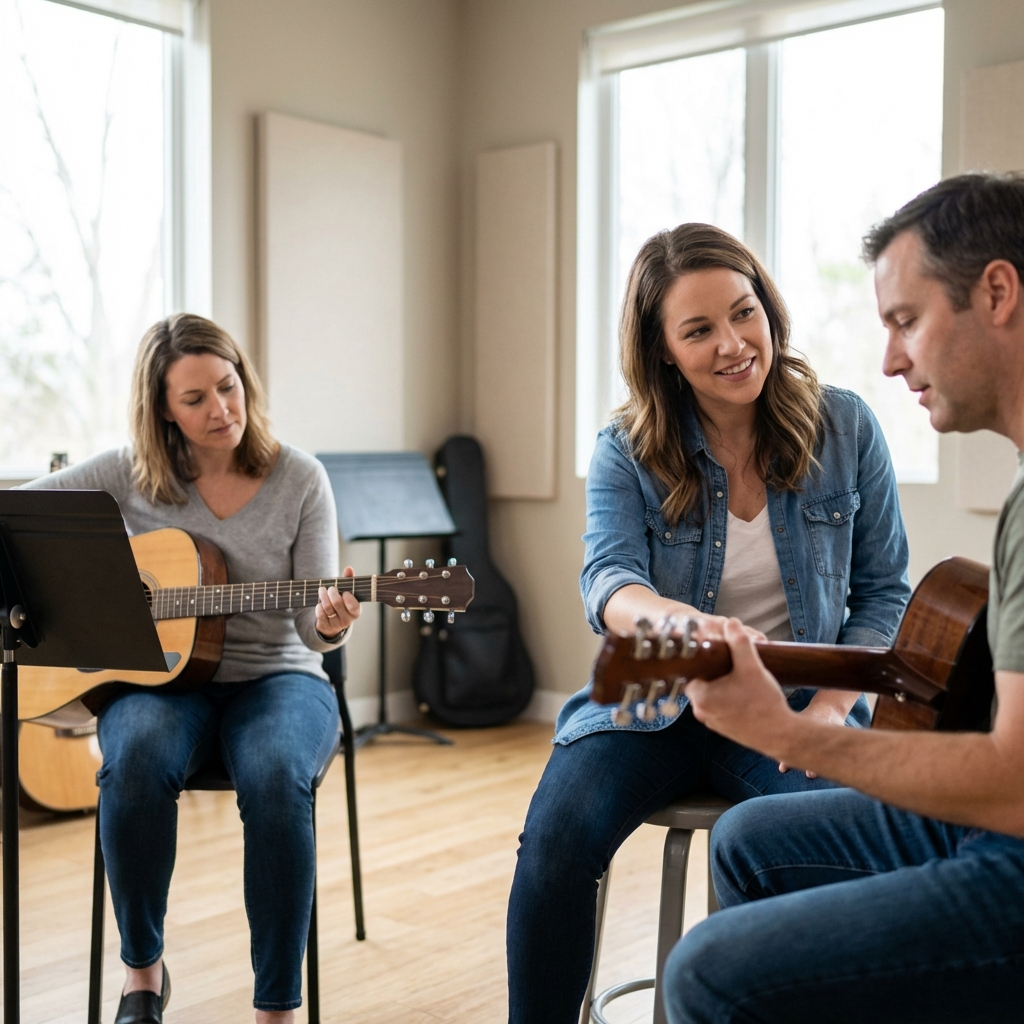
At East Valley School of Music, instructors tailor lessons to individual pace and learning style, integrating technique with repertoire. If you’re unsure about fit, schedule a trial lesson and bring a short list of songs you enjoy—this helps the teacher design a path that keeps you engaged.
Common Beginner Mistakes to Avoid
Every player starts somewhere. Avoiding a few typical pitfalls can save time and prevent frustration.
Watch out for:
- Gripping too hard: excess tension slows chord changes and causes soreness. Use minimal pressure and keep the thumb relaxed.
- Oversized or uncomfortable guitars: a poor fit discourages practice. Choose a body size and neck profile that suit your hands and shoulders.
- Skipping rhythm training: counting and steady strumming are non-negotiable. Practice with a metronome or drum loop early on.
- Ignoring tuning: out-of-tune playing masks progress. Tune at the start of every session and recheck after temperature changes.
- Relying only on tabs: tablature is useful, but basic note and rhythm reading deepen understanding and ensemble readiness.
- Unstructured practice: short, focused blocks beat long, unfocused sessions. Set micro-goals like “10 clean transitions from G to D.”
- Neglecting maintenance: old strings and high action make everything harder. Replace strings regularly and get basic setups as needed.
- Jumping ahead too fast: mastery comes from repetition. Level up after you can play cleanly at consistent tempos.
If you catch yourself struggling, tell your teacher where the difficulty appears—on the third finger in a chord, during upstrokes, or at a particular tempo. Specific feedback allows targeted fixes.
Getting Started With Your Guitar Journey
Launching your guitar path in Chandler can be straightforward when you follow a clear plan.
Suggested first steps:
- Define your goals: a favorite song to learn, a style you love, or a recital date to aim for.
- Choose your instrument: discuss nylon vs. steel-string or electric based on comfort and musical taste; explore Milano Music rental options through EVSM if you’re not ready to buy.
- Set up your practice space: chair, music stand, clip-on tuner, and a quiet corner where you can focus.
- Book your first lesson: share your interests and schedule so your instructor can prepare a right-sized starter plan.
- Establish routine: 15–25 minutes on weekdays is powerful for beginners; log wins and questions to discuss in lessons.
- Plan for performance: consider EVSM’s biannual recitals or low-pressure studio share events as early, achievable milestones.
East Valley School of Music supports new players with personalized one-on-one instruction, a welcoming learning environment, and meaningful performance opportunities in a dedicated 100-seat hall. Whether you’re exploring children guitar instruction for a young beginner or aiming to learn guitar as an adult with a structured, professional approach, Chandler offers the resources to make consistent progress.
If you’re ready to begin, reach out to schedule a first lesson, explore instrument rental options, and map your next three months. With the right teacher, a well-fitted guitar, and a steady routine, your first song—and your confidence—will arrive sooner than you think.