Structured Practice Routines: Building Consistency and Momentum
7 Best Strategies for Fast Piano Progress as an Adult Beginner in Chandler
Starting piano as an adult is both practical and rewarding. You bring discipline, clear goals, and a musical taste you’re eager to play. The key to moving quickly isn’t rushing—it’s building a plan that respects your schedule while reinforcing the right skills at the right time. For learners in Chandler, tapping into structured routines, qualified coaching, and the local resources available through East Valley School of Music can turn effort into measurable gains week after week.
Below are seven strategies calibrated for fast piano lessons for adults, with concrete steps you can apply immediately.
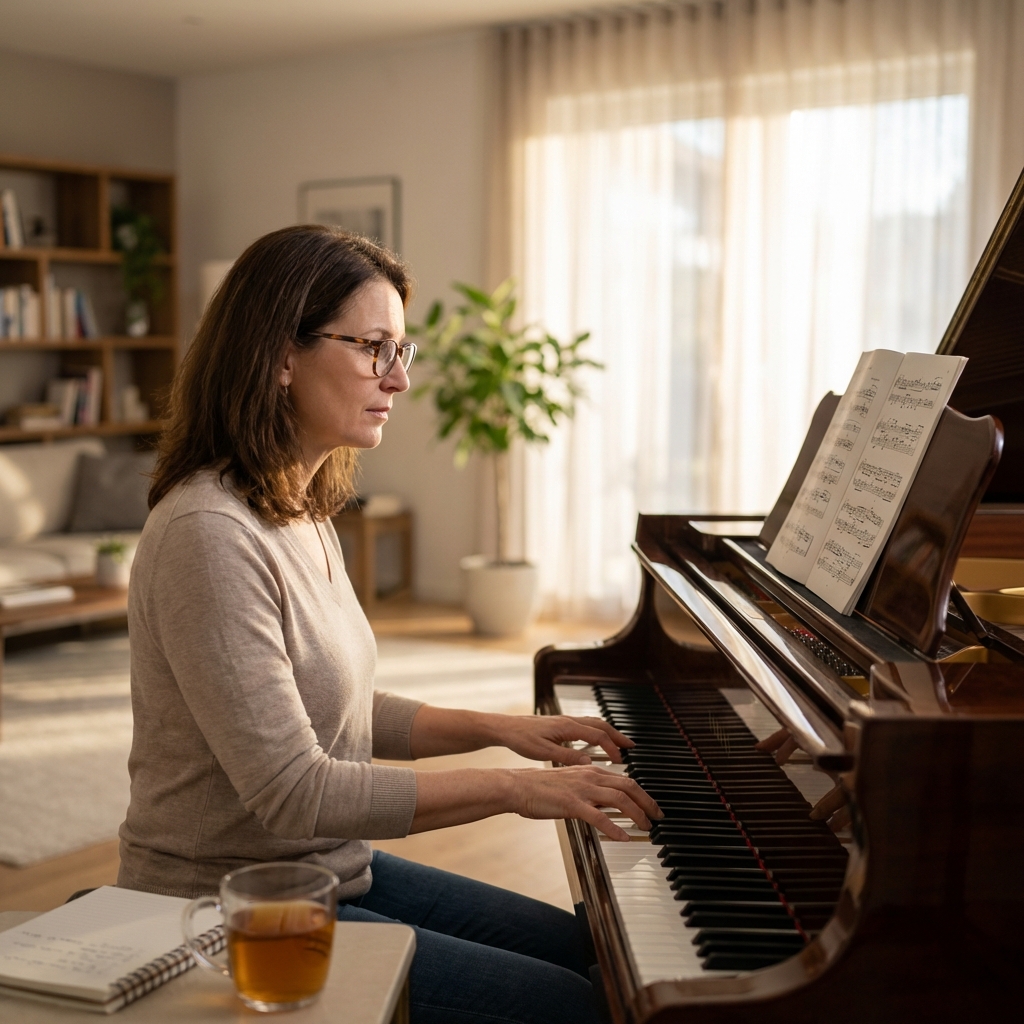
Adults progress fastest when practice time is predictable and focused. Think of practice as an appointment you keep with yourself: same time, same place, a clear plan. Consistency reduces the mental “startup cost,” so you spend more minutes making music and fewer deciding what to do.
Start by building a weekly micro-cycle:
- 4 days of focused practice (20–40 minutes each)
- 1 day of light review (10–15 minutes)
- 2 days off for recovery and listening
Within that cycle, rotate emphasis to keep skills balanced:
- Day 1: Technique + hands-together coordination
- Day 2: Note reading + rhythm drills
- Day 3: Repertoire shaping + dynamics
- Day 4: Review weak spots + performance run-through
- Light day: Sight-reading and ear training
Use a session blueprint so you always know the next step:
- 3 minutes: Warm-up and posture check (bench height, relaxed shoulders, curved fingers)
- 6–8 minutes: Technique (five-finger patterns, broken chords, scales at a slow, accurate tempo)
- 8–12 minutes: Repertoire (two focused passages, hands separate, then together)
- 3–5 minutes: Musicianship (rhythm clapping, interval recognition, or simple chord labeling)
- 2 minutes: Quick performance play-through or recording for feedback
Set one improvement target per session—e.g., “Clean left-hand eighth notes in measures 9–16 at 60 bpm.” This single-point focus drives momentum.
Two tactics that work well for adult beginner piano lessons:
- Implementation intention: “After dinner, I sit at the piano for 20 minutes before opening email.” You’ve defined the trigger and action.
- Session cap: End on time and on a win. Stopping before fatigue keeps your next session easier to start.
Finally, keep a practice journal. Note metronome settings, fingerings that solved problems, and what to attempt next. Seeing small gains on paper makes progress concrete and encourages consistency—critical for quick piano learning methods that stick.
One-on-One Instruction: Why Personalized Lessons Accelerate Learning
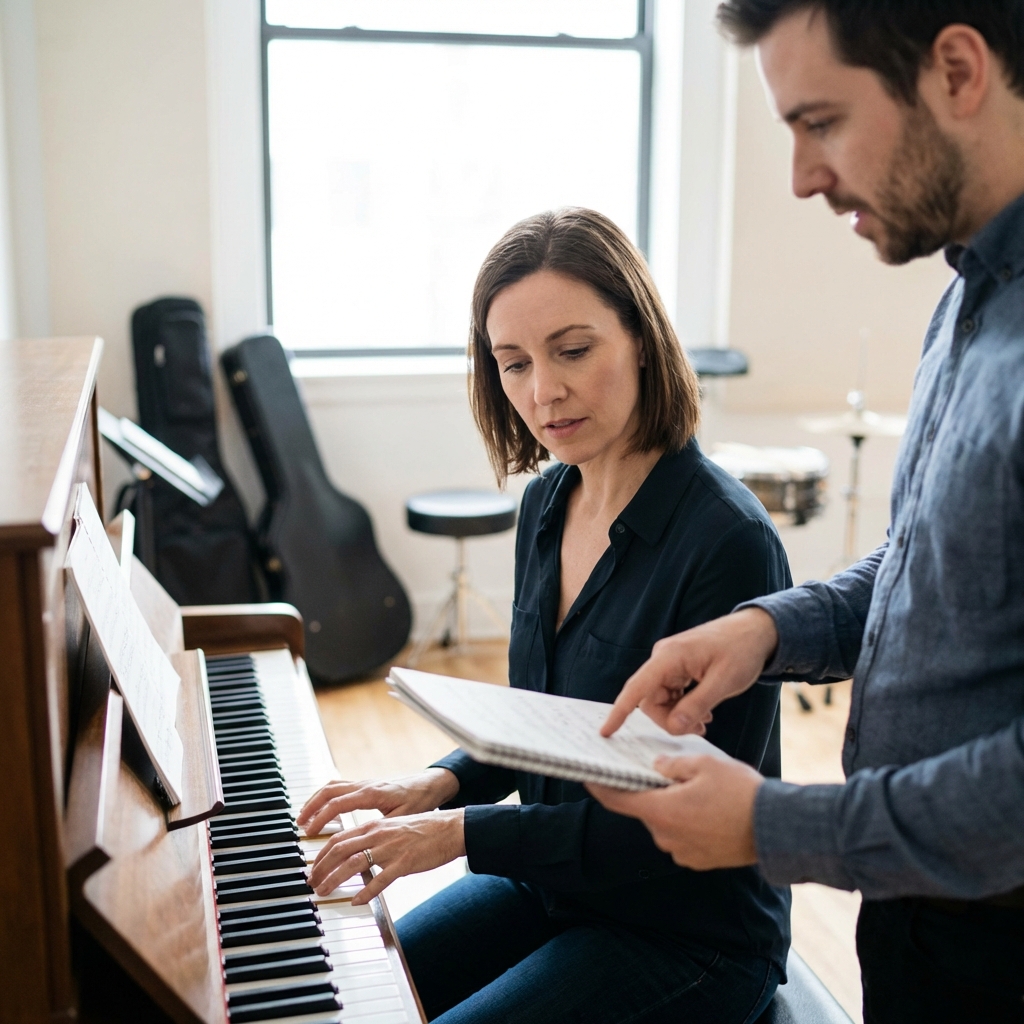
Adults often juggle work, family, and self-improvement. In that reality, a great private instructor is a force multiplier. Personalized lessons compress the trial-and-error phase by identifying exactly which habits, fingerings, or reading strategies will unlock your next breakthrough.
What a strong teacher does for speed:
- Diagnoses the single bottleneck limiting a piece (e.g., thumb-under tension in C major scale) and fixes it early.
- Chooses repertoire that’s musically satisfying yet correctly leveled, so you improve reading, rhythm, and coordination in tandem.
- Demonstrates efficient movement—weight transfer, wrist rotation, and forearm alignment—reducing injury risk and wasted effort.
- Structures feedback loops. Weekly check-ins prevent small mistakes from calcifying into long-term barriers.
Adults benefit from targeted musical “shortcuts” that aren’t shortcuts at all—they’re best practices:
- Micro-voicing exercises to bring out melody in the right hand while softening accompaniment
- Rhythmic subdivision to stabilize syncopation without guesswork
- Chordal mapping, so you see patterns rather than isolated notes
If you’re considering piano lessons Chandler-wide, evaluate a studio’s approach to adult pacing and scheduling. At East Valley School of Music, Private piano lessons are taught by degree-holding instructors who tailor materials and lesson flow to your goals, whether that’s reading lead sheets, accompanying at church, or playing Debussy.
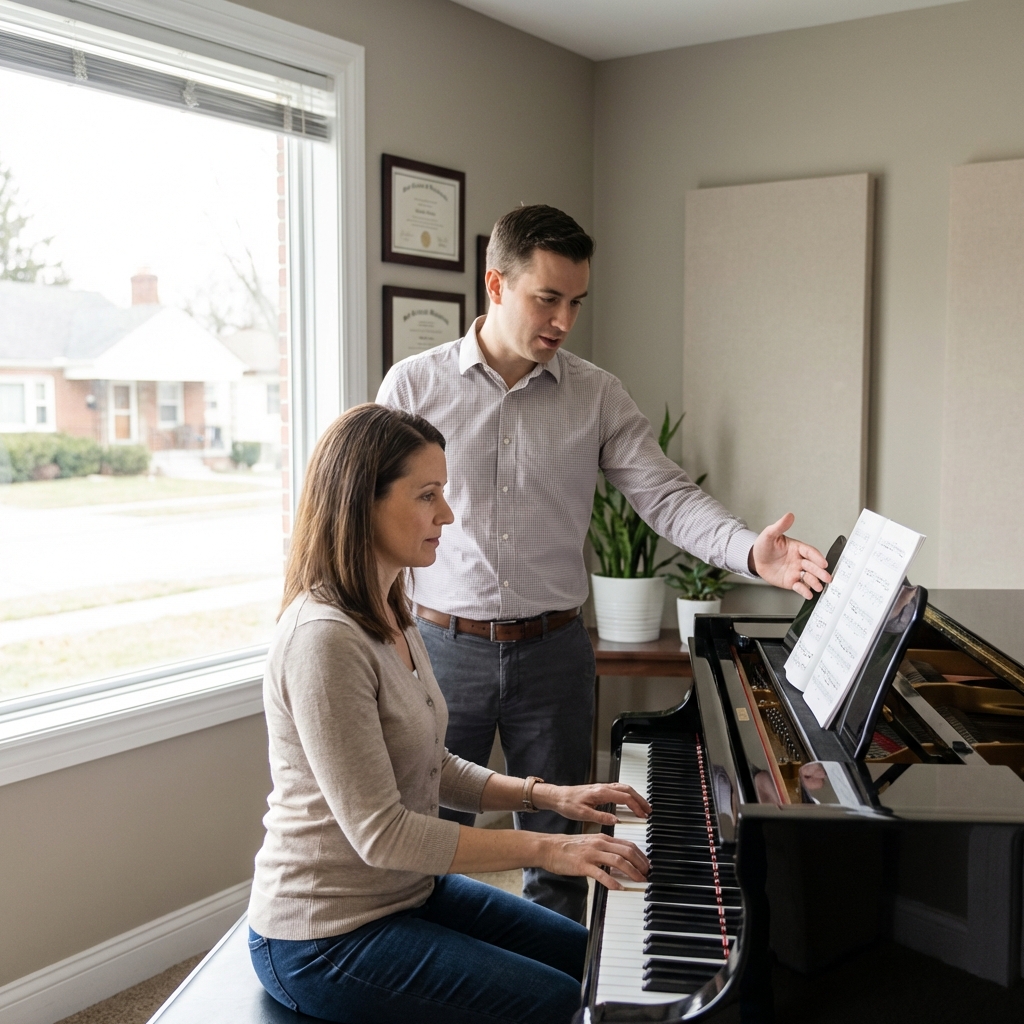
One final accelerant: real-time correction. A teacher watching your hands can spot minute tension in the thumb, a collapsing knuckle, or drifting tempo—issues that slow adults disproportionately because they’re often unnoticed. Swift feedback early on helps align daily practice with correct technique, so every minute counts toward faster, lasting progress.
Goal-Oriented Lesson Planning: Setting Realistic Milestones
Clear milestones separate forward motion from wheel-spinning. Adults who improve rapidly know what they’re building each month—and why. Start with a 12-week sprint plan aligned to one or two capstone tasks, such as “perform a two-page piece with both hands at 84 bpm” or “sight-read a simple lead sheet with correct chord roots.”
Use SMART goals: Specific, Measurable, Achievable, Relevant, Time-bound. For example:
- Technique: Play C, G, and F major scales two octaves, hands separately at 72 bpm, even tone.
- Reading: Sight-read eight bars at level 1–2 daily, keeping a steady pulse with minimal stops.
- Repertoire: Shape phrasing and dynamic contrast in one primary piece and one contrasting study.
Design a laddered repertoire path. Each piece adds a new challenge while reinforcing prior skills:
- Week 1–3: Short pieces focusing on legato touch and simple hand coordination
- Week 4–6: Pieces with tied rhythms and basic pedal changes
- Week 7–9: Introduction of alberti bass or broken-chord patterns
- Week 10–12: Two-voice texture control and a short memorized section
Build a feedback dashboard:
- A metronome log showing top comfortable tempo for scales and key passages
- A checklist for elements mastered (fingerings confirmed, rhythms counted aloud, pedaling mapped)
- Two self-recordings per month, annotated with observations
If you’re pursuing accelerated music instruction, agree with your teacher on weekly benchmarks to remove ambiguity. Ask, “What must be true by next Monday?” The answer might be, “Left-hand eighth-note ostinato steady at 66 bpm, 90% accuracy, eyes on score.”
Families using Arizona’s Empowerment Scholarship Account (ESA) often appreciate documentation. East Valley School of Music is ESA reimbursement eligible, and instructors can provide records of lesson attendance and progress summaries—useful for budgeting and oversight while keeping your 12-week plan on track.
Daily Practice Habits: Making the Most of Your Time
Speed hinges on high-yield daily habits. Short, focused sessions outperform occasional marathons because the brain consolidates skills between practices. Even 15 to 25 minutes, five days a week, will move you faster than a single weekend hour.
Adopt these quick piano learning methods that map to adult constraints:
- Slow is smooth; smooth is fast. Practice a passage at a speed where accuracy is automatic, then nudge the metronome by 2–4 bpm. Avoid jumping from 60 to 80 in one leap.
- Interleaving beats blocking. Alternate between two tricky spots rather than drilling one section to exhaustion. This boosts retention and adaptability.
- Mental rehearsals count. Visualize hand movements and hear the passage in your head while away from the piano. Even two minutes solidifies pathways.
- Isolate the “error bar.” If the mistake lives in measures 13–14, practice only 12–15, not the whole page.
- Count aloud and tap rhythms before playing. Separating rhythm from notes removes guesswork.
A 25-minute adult session template:
- 2 minutes: Body setup—bench height so forearms are parallel to the floor; relaxed shoulders
- 6 minutes: Technique—Hanon No. 1 or simple five-finger patterns, plus one scale hands separate
- 10 minutes: Repertoire—two problem measures looped with a metronome, then add surrounding bar
- 5 minutes: Musicality—shape dynamics (mp vs mf), check phrasing slurs, one slow performance pass
- 2 minutes: Journal—note metronome mark and tomorrow’s focus
Use small triggers to start. Place your music open to the day’s piece, keep a pencil on the stand, and set a repeating phone reminder. Reducing micro-friction leads to more starts, and more starts add up to faster outcomes—especially for fast piano lessons for adults where time is precious.
Finally, record yourself twice a week. The microphone hears what we miss in the moment: rushing, uneven tone, pedal blur. Play back at 0.75x speed, identify one fix, and apply it the very next day.
Choosing the Right Instructor: Finding Experience and Teaching Style Match
Progress accelerates when teaching style matches how you learn. Before enrolling, define your priorities: Are you reading-based, chord/lead-sheet focused, or classical repertoire oriented? Do you want structured syllabi or exploratory learning? Your answers guide the instructor search.
Evaluate an adult-focused teacher on:
- Credentials and specialization: Degree-holding, with experience teaching adults at your level
- Communication style: Clear demonstrations, concise assignments, and constructive feedback
- Techniques taught: Healthy biomechanics, efficient fingering strategies, musical phrasing from the start
- Materials: Modern method books for adults (e.g., Faber Adult, Alfred Adult), plus graded repertoire, rhythm work, and ear training
- Structure: Written lesson notes, measurable weekly targets, and regular reviews
- Flexibility: After-work hours, hybrid lesson options if needed, understanding of adult schedules
- Track record: Student performances, consistent progress stories, and a calm, professional studio environment
Ask focused questions during a trial lesson:
- “How will you help me coordinate both hands more quickly?”
- “What do you assign between lessons to build reading and rhythm without overwhelm?”
- “How do you adapt when a piece is too hard or too easy?”
- “What’s your plan for getting me performance-ready within three months?”
For piano lessons Chandler learners, proximity matters too—consistent attendance often hinges on a manageable commute. East Valley School of Music offers degree-holding faculty and a structured, supportive environment. Browse Our instructors to compare backgrounds and teaching philosophies, and consider how each aligns with your goals. If you’re a family using ESA, ask about reimbursement processes and documentation so billing supports, rather than complicates, your routine.
You may also complement one-on-one lessons with collaborative classes in rhythm or theory. Adults frequently report that a periodic group dynamic session reinforces fundamentals without sacrificing the tailored focus of private instruction.
Instrument Investment: Why Quality Matters for Faster Progress
Your instrument either enables progress or fights it. Adults learning quickly need an instrument that rewards correct technique and reveals inconsistencies clearly. A low-quality keyboard with unweighted or semi-weighted action obscures touch and timing, making it harder to develop control and musicality.
Aim for these minimum specs:
- 88 keys, fully weighted, hammer action with an escapement-style response
- Responsive velocity layers that translate finger pressure into dynamic range
- Sustain pedal (preferably a piano-style pedal, not an on/off switch)
- Stable stand and an adjustable bench to maintain posture
- Headphone output for quiet practice and a metronome function
Digital pianos are ideal in many Chandler apartments and homes due to volume control and zero-tuning needs. They support daily consistency, which underpins accelerated music instruction. If you prefer acoustic, budget for professional tuning 1–2 times per year and occasional regulation; a responsive action transforms the learning curve.
At East Valley School of Music, you’ll find guidance on instrument options, and as a Milano Music instrument rental agent, the school can help you access reliable rentals that meet practice needs without a large upfront purchase. Rental-to-own paths can reduce initial costs while letting you train your hands on proper key weight and pedal feel from day one.
Small setup details compound into speed:
- Bench height so wrist and forearm align; avoid a sinking wrist, which limits agility
- Music stand at eye level to reduce neck tension; add a small lamp for consistent lighting
- Pedal placement under the ball of the foot; practice half-pedal and clear pedal changes early to prevent blur
If you already own a light-action keyboard, consider upgrading or supplementing with scheduled access to a weighted instrument—either at a studio or via short-term rental—especially during technique-building months. Every minute spent on authentic key resistance and pedal response transfers directly into faster, cleaner progress.
Performance Opportunities: Building Confidence Through Recitals
Performing might feel optional, but it’s a powerful accelerator. A concrete date sharpens practice, reveals what holds under light pressure, and builds the poise to play for others—skills that translate into every future piece you learn.
Adults benefit from staged exposure:
- Studio class or small group share: Low stakes, immediate feedback
- Mock run-throughs at home: Record a complete take with no stopping, even if imperfect
- Formal recital: Dress rehearsal one week prior, performance day with supportive audience
East Valley School of Music offers biannual student recitals that give adults a clear, motivating target. The school’s 100-seat performance hall is also available for rentals, providing an acoustically appropriate space to rehearse and present pieces. Practicing on a real stage—walking to the bench, setting the tempo, shaping dynamics in a resonant room—builds skills you can’t acquire at home.
Create a four-week recital ramp:
- Week 4 out: Finalize fingerings and form; two slow, accurate run-throughs per day
- Week 3 out: Stabilize tempo; interleave troublesome measures with full takes
- Week 2 out: Musical polish—dynamics, voicing, pedal clarity; record and review three times this week
- Week 1 out: Dress rehearsal and light maintenance; prioritize rest and mental run-throughs
A recital checklist for adult beginner piano lessons:
- Score markings for every critical entrance, lift, and pedal change
- “Safe tempo” chosen—slightly under your top comfortable speed
- Two contingency plans: where to restart if you blank, and how to end musically if needed
- Performance mindset cue: one sentence you repeat at the bench (“Breathe, sing the melody, steady pulse”)
Community performances around Chandler—open mics, church services, or casual gatherings—also provide friendly milestones. Rotate pieces so you’re not constantly re-learning under pressure. The goal isn’t perfection; it’s resilience and musical storytelling.
With fast piano lessons for adults, performances are not the finish line; they’re part of the training cycle. Each outing clarifies the next set of practice priorities, making your time at the keyboard more targeted and your progress measurably quicker.
—
Adult learners make rapid gains when structure, feedback, and environment align. Build a week you can repeat, choose instruction that fits your goals, set measurable milestones, and practice with intent on an instrument that rewards good technique. Add periodic performances to transform skills into confidence. For Chandler-area students, the resources at East Valley School of Music—from personalized instruction and collaborative classes to recital opportunities and rental guidance—are designed to support exactly that kind of steady, accelerated growth.