
Learning to play the electric guitar is an exciting, totally achievable goal. It really just boils down to three things: picking the right gear, learning the basic techniques, and putting in the practice time. You'd be surprised how quickly you can get there—most beginners can strum along to simple songs within just a few weeks.
Your Electric Guitar Journey Starts Now
So, you're ready to learn electric guitar. You’ve probably already imagined yourself hitting that first crunchy power chord or nailing a solo from one of your favorite songs. That's not just a daydream; it’s a very real goal, and this guide is here to be your roadmap.
First, let's get one thing straight: you don't need some kind of innate "talent" to do this. Learning an instrument is a skill, plain and simple, and it's built piece by piece through smart practice and a bit of patience. My goal here is to cut through all the jargon and give you a clear, step-by-step plan that feels encouraging, not overwhelming. We'll focus on building a solid foundation, one small win at a time.
A Clear Path Forward
When you break it down, the whole journey is much simpler than it looks. It really comes down to three main phases. This visual shows you the logical path from picking up your first guitar to actually making music with it.
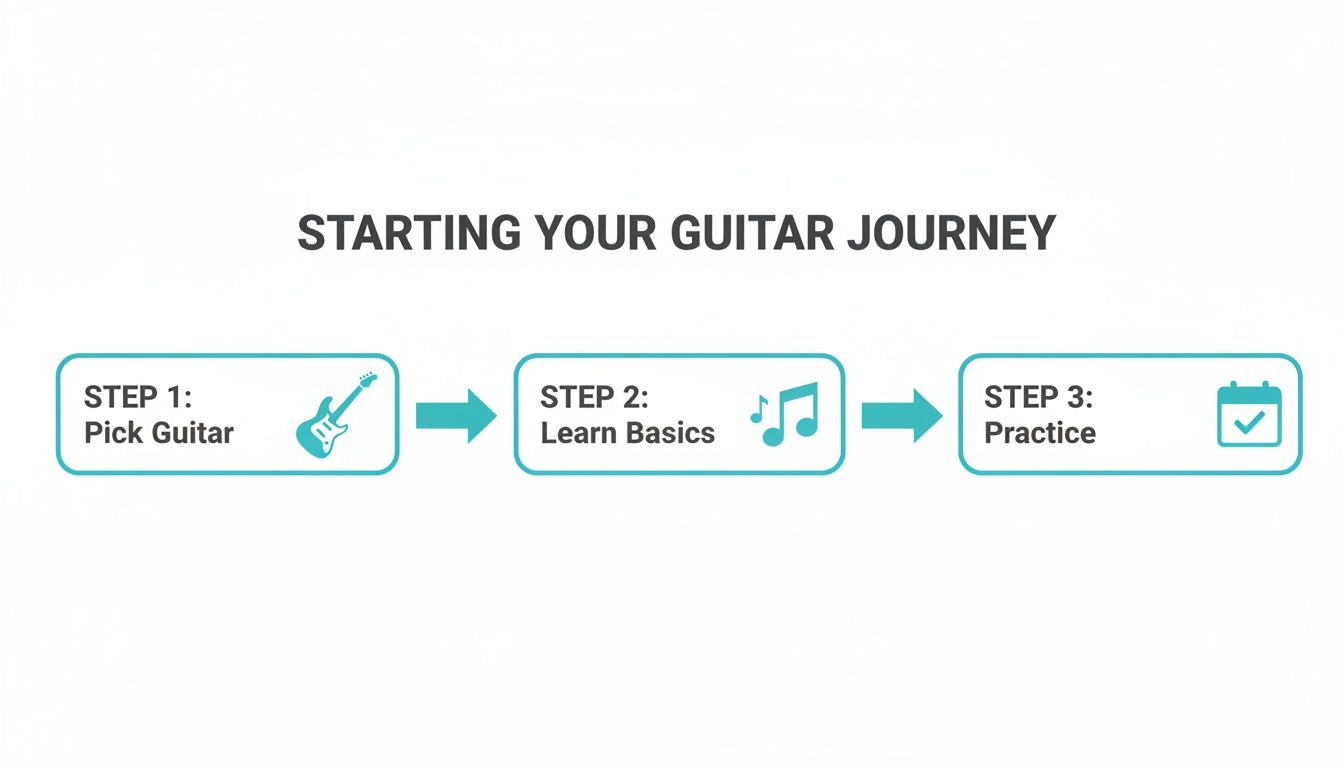
See? It's not about one giant leap. It’s all about taking small, manageable steps that naturally build on each other.
You couldn't have picked a better time to start. The electric guitar is more accessible than ever, with electrics making up 58% of all guitar sales in the US in 2023. This boom, fueled by new players just like you, means there’s an amazing selection of high-quality, affordable beginner gear out there. If you want to dive deeper into the numbers, you can find more insights on the growing guitar market from Data Bridge Market Research.
The most important thing is to simply begin. Don't worry about being perfect from day one. Your only goal is to pick up the guitar, make some noise, and have fun. Progress will follow naturally from there.
To help you get organized, here’s a quick checklist of the first few milestones you'll want to hit.
Beginner's Quick Start Checklist
| Milestone | Key Action | Why It Matters |
|---|---|---|
| Get Your Gear | Choose a beginner-friendly electric guitar, a small practice amp, and essential accessories (tuner, picks, cable). | Having the right tools makes learning easier and more enjoyable, preventing unnecessary frustration. |
| Learn the Anatomy | Familiarize yourself with the parts of the guitar and amp—know your headstock from your bridge, your volume from your tone knob. | Understanding your instrument is the first step to controlling it. |
| Master Your Posture | Learn how to sit or stand correctly with the guitar, including proper hand and finger positioning. | Good habits from day one prevent strain and make playing chords and notes much cleaner. |
| Make Some Noise! | Practice basic strumming and pick a few simple chords to learn, like G, C, and D. | This is where the fun begins! It builds your foundational muscle memory and ear for music. |
This table lays out the immediate goals. As you check these off, you’ll be building a fantastic foundation.
This guide will walk you through these initial steps in detail. Later on, we’ll also look at how a structured learning environment, like the programs we offer at the East Valley School of Music, can really speed up your progress with expert guidance and a community of fellow learners.
Finding Your First Guitar and Amp
Alright, let's talk about gear. Picking out your first electric guitar is a huge, exciting step, but it's easy to get lost in all the options. The main goal here is simple: find an instrument that feels good in your hands and, most importantly, makes you want to play it. Don't worry about the technical jargon just yet. Focus on comfort.
The good news? You've picked a great time to start. The global electric guitar market soared to $4.72 billion in 2024, and the biggest leap was in entry-level models under $300, which saw a 15% jump in sales over the last year. For you, this means there are more high-quality, affordable starter guitars on the shelves than ever before. You can read more about the electric guitar market surge on Guitar Muse if you're curious.
Choosing a Guitar That Fits You
Walk into any guitar shop, and you'll likely see two classic shapes dominating the walls: the Stratocaster (or "S-style") and the Les Paul (or "LP-style").
- S-Style Guitars: These are known for their contoured bodies that feel comfortable whether you're sitting or standing. They're typically lighter, have thinner necks, and offer a really versatile sound, making them a fantastic starting point for almost any genre.
- LP-Style Guitars: With their iconic single-cutaway body, these guitars often have a thicker, heavier feel and produce a warm, powerful tone that’s the bedrock of countless rock and blues songs.
My best advice? Go to a store and physically hold both types. Don't be intimidated. Just ask if you can sit down with one for a minute. Pay attention to how it balances on your lap and how the neck feels in your hand. That initial connection is way more important than the brand on the headstock when you're just starting out.
Don't Forget the Amplifier
An electric guitar without an amp is like a car without an engine. It's only half the package. For your first rig, all you really need is a small practice amp. These are designed to sound great at lower volumes, which will definitely keep your family and neighbors on good terms with you.
I highly recommend looking for a "modeling" amp. These little wonders digitally replicate the sounds of famous, expensive amplifiers and effects. It's like having a whole collection of gear packed into one small box. This lets you experiment with everything from crystal-clear pop tones to gritty rock distortion, which is a huge part of finding your own sound. A simple 10 to 20-watt modeling amp is the perfect place to start.
Your first amp doesn't need to be loud; it needs to be inspiring. Having access to different sounds will keep your practice sessions fun and help you discover the musical styles you enjoy playing most.
The Must-Have Extras
Besides the guitar and amp, you'll need a few other things to get going. Here’s a quick checklist to make sure you have the essentials covered:
- Guitar Cable: This is what connects your guitar to the amp. A 10-foot cable is usually plenty.
- Picks (Plectrums): Grab a variety pack. They come in different thicknesses, and trying a few will help you find what feels best for your playing style.
- Electronic Tuner: A clip-on tuner is your best friend. It’s easy to use and absolutely essential for making sure you sound in tune.
- Guitar Strap: You'll want one of these so you can practice standing up, which feels very different from sitting down.
If you’re not quite ready to purchase everything, renting is a fantastic way to get your hands on a quality instrument without the big upfront cost. It’s a low-risk way to see if the guitar is truly for you. You can learn more about instrument rental programs and see if it’s the right move for you.
Mastering Your First Chords and Sounds
Alright, you've got the gear. Now for the fun part: making some noise. This is where the abstract ideas turn into actual music, the moment you start to feel like a real guitarist. And it all begins with the fundamentals—the same building blocks that your guitar heroes use every single day.
Let’s start with how you hold everything. Getting this right from the beginning saves you a ton of frustration later on. Sit up straight and let the guitar rest on your leg. Your fretting hand (the one on the neck, usually your left) should create a nice, relaxed "C" shape. Your thumb rests gently on the back of the neck, acting as a pivot point. Whatever you do, don't strangle the neck like it's a baseball bat. You need your fingers loose and ready to move.
As for the pick, just pinch it between your thumb and the side of your index finger. You want a grip that's firm but not a death grip. When you strum, think of the motion coming from your wrist, not your whole arm. A stiff arm equals a choppy, clumsy sound.
Cracking The Code Of Chords
Before you can play chords, you have to be able to read them. You'll run into two common ways guitar music is written down: chord diagrams and tablature (tabs for short).
- Chord Diagrams: Think of these as a snapshot of the fretboard. The vertical lines are your strings (fattest on the left), and the horizontal lines are the frets. The dots simply show you where to put your fingers.
- Tablature (Tabs): This is a super straightforward way to read melodies and riffs. Tabs use six lines, one for each string, and the numbers tell you which fret to press down.
Now that you can read the map, you're ready to learn your first few chords. These three open chords are the backbone of countless rock, pop, and blues songs.
Here’s a look at the first three chords every budding guitarist should know. Getting these down will unlock hundreds of songs for you.
Your First Three Electric Guitar Chords
| Chord Name | Fingering Guide | Common Songs That Use It |
|---|---|---|
| E minor (Em) | Place your middle finger on the 2nd fret of the A string and your ring finger on the 2nd fret of the D string. Strum all six strings. | "Seven Nation Army" by The White Stripes, "Zombie" by The Cranberries |
| G major (G) | Place your middle finger on the 3rd fret of the low E string, index finger on the 2nd fret of the A string, and ring finger on the 3rd fret of the high E string. | "Sweet Home Alabama" by Lynyrd Skynyrd, "Good Riddance (Time of Your Life)" by Green Day |
| C major (C) | Place your ring finger on the 3rd fret of the A string, middle finger on the 2nd fret of the D string, and index finger on the 1st fret of the B string. | "Wonderwall" by Oasis, "Let It Be" by The Beatles |
Take your time and focus on one chord at a time. Make sure your fingertips are pressing down firmly just behind the metal fret wire. This is how you get a clean sound without any annoying buzzing. And don't get discouraged if it sounds a bit messy at first—that's completely normal for everyone.
Want a pro tip for learning parts by ear? Check out stem separation software. This kind of tool can pull the guitar track out of a song, so you can hear exactly what you’re trying to copy without all the other instruments in the way.
The goal isn't speed, it's clarity. Strum a chord, then pick each string one by one. If a note is dead or buzzing, shift your finger a little or press harder until it rings out. This one habit will pay off big time.
Once you can form each chord without looking, grab a metronome. Set it to a nice, slow pace, maybe 60 BPM, and just strum down on every click. The real challenge is switching between chords smoothly without stopping or slowing down the rhythm.
Mastering this is the key to actually playing songs. To keep building your chord vocabulary, feel free to dive into our other guides on essential guitar chord lessons.
Building a Practice Routine That Actually Works
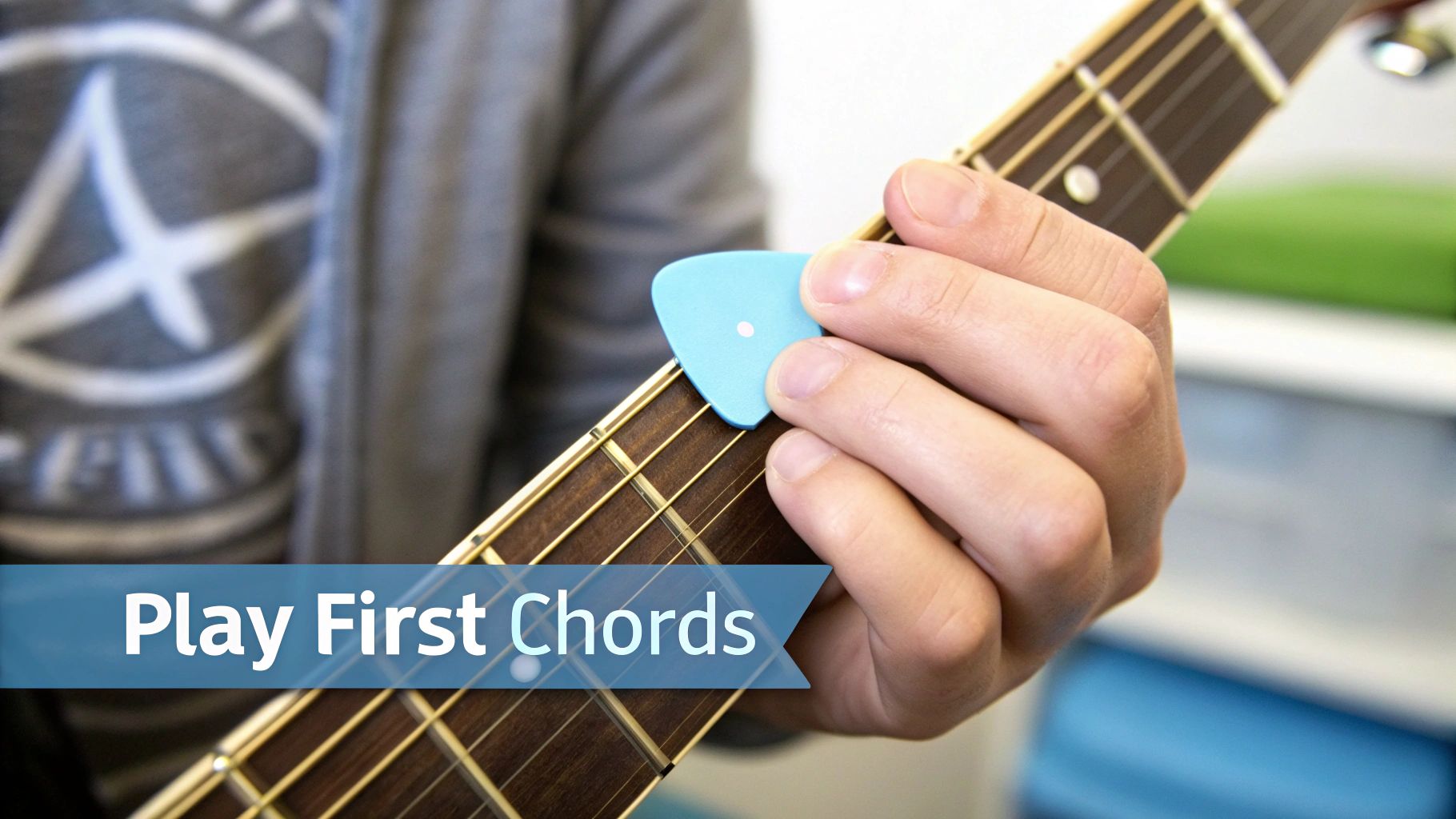
Alright, you’ve got the gear and you’re starting to get the hang of a few chords. This is where the real work—and the real fun—begins. The single most important part of your journey to learn play electric guitar is building a practice habit that actually sticks around.
The secret isn't about locking yourself in a room for hours on end. It’s all about consistency.
Think of it this way: your brain and fingers learn through repetition. Short, focused sessions every day are vastly more effective than one marathon practice on a Saturday. This daily work builds muscle memory and makes picking up your guitar feel as natural as grabbing your morning coffee, not like a chore you have to psych yourself up for.
All you need is 20 minutes a day. Seriously. It’s a small, manageable chunk of time that you can almost always find, no matter how packed your schedule is.
Designing Your 20-Minute Session
So, how do you make those 20 minutes count? The last thing you want is to just noodle around without a plan. Having a little structure ensures you're hitting all the important skills without getting sidetracked or bored. A balanced routine builds your physical dexterity and your musical ear at the same time.
Here's a simple, battle-tested breakdown that works wonders:
- Minutes 1-3 (Warm-Up): Don't just jump into it cold. Start by gently stretching your fingers. Then, try a simple finger exercise like the "spider walk"—placing one finger on each of the first four frets, one string at a time, and crawling up and down the neck. It gets the blood flowing and wakes up your hands.
- Minutes 4-9 (Chord Changes): This is your bread and butter. Pick two chords you’re working on (like E minor and G major) and just switch between them. Use a metronome set painfully slow. The goal here is to make the transition smoothly and in time. Trust me, timing is more important than perfect accuracy right now. A chord that buzzes a little but lands on the beat is way better than a perfect-sounding chord that's late.
- Minutes 10-14 (Scale Practice): Now, let's work on something for lead playing. Run through a simple scale, like the minor pentatonic. This scale is the foundation for countless rock and blues solos. Play it up and down, nice and slow, focusing on making every single note ring out clearly.
- Minutes 15-20 (The Fun Part): Time for your reward! Use these last few minutes to work on a simple riff from a song you actually love. Maybe it's the intro to "Seven Nation Army" or "Smoke on the Water." This is what it's all about—playing real music and reminding yourself why you started this journey in the first place.
The most powerful tool for improvement is repetition over time. Practicing every day, even for just a few minutes, trains your finger memory and solidifies new skills in a way that cramming never can.
Staying Motivated and Tracking Progress
Look, motivation is going to come and go. Some days you’ll feel like a rock god in the making; others, you'll feel like you've made zero progress. That’s completely normal, I promise. The trick is to have a few systems in place to pull you through those rough patches.
One of the best things you can do is set tiny, achievable goals each week. Don't just say "I'll get better at chords." Instead, make it specific: "This week, I will switch between G and C chords 10 times in a row without stopping." It's clear, it's measurable, and you'll know exactly when you've done it.
When you hit that goal, celebrate it! Then set a new, slightly harder one for the next week. This little cycle of accomplishment is a huge motivator. It also helps to jot down your progress in a notebook. When you look back after a month, you'll be genuinely shocked at how far you've come.
Navigating Common Beginner Roadblocks
Everyone hits a few snags when they first learn to play electric guitar. It's just part of the deal. Every single guitarist you look up to has been exactly where you are now, fumbling through chords and dealing with sore fingers. The trick is to see these little hurdles as puzzles to solve, not reasons to quit.
One of the first things you'll notice? Sore fingertips. After a few good practice sessions, the tips of your fretting fingers will probably feel pretty tender. Believe it or not, this is a good sign! It's your body building the calluses you need to play without pain. Don't let it stop you, but do take short breaks if you need them. The soreness usually goes away for good in a week or two.
Then there's the dreaded string buzz. You’re sure you're pressing down on the right note, but all you get is an annoying rattle instead of a clean, clear tone. This almost always boils down to two things: where your finger is and how hard you're pressing.
- Finger Placement: Your fingertip needs to be right behind the metal fret, as close as you can get without being on top of it. If you're too far back in the middle of the fret, you'll get buzz.
- Pressure: You need to apply firm, steady pressure. It’s not a death grip, but a flimsy touch just won’t cut it. The string will vibrate against the fret instead of ringing out cleanly.
Basically, your finger is creating a new endpoint for the string. If it's not held down securely, things get messy.
Smoothing Out Your Chord Changes
Slow, clunky chord changes can make you want to throw your guitar out the window. I get it. Going from a G to a C can feel like your fingers are doing impossible yoga poses. The secret isn't speed—it's slow, deliberate practice to build muscle memory.
Here’s a pro tip: Keeping the rhythm is more important than a perfect chord change. A slightly muted or flubbed note that’s in time sounds way better than a perfect chord that's late to the party.
Pick two chords to work on. Forget strumming for a minute and just move your hand back and forth between the two shapes. Focus on making all your fingers move together as a single unit. Once that feels a bit more natural, bring in a metronome at a super slow speed, maybe 50 BPM. Strum each chord four times, making sure you switch right on the beat. Only speed it up when you can do it cleanly.
Finding Your Rhythm
Speaking of the beat, getting your internal clock in sync is a huge challenge for a lot of new players. It’s easy to rush or drag without even noticing. Your metronome is your best friend here; it doesn't lie.
Start with the absolute basics. Set the metronome and just practice strumming muted strings (by lightly touching them with your fretting hand) in time with the click. Just down strums. Get the feel of locking in with that pulse. This simple exercise builds the rhythmic foundation you need for, well, everything else in music. Pushing through these early walls is where real skill and confidence are born.
When to Consider Taking Guitar Lessons
Learning on your own is a fantastic way to start your electric guitar journey, but almost every player eventually hits a wall. It’s a totally normal part of the process, and frankly, it’s often the perfect time to think about getting some real guidance from a seasoned instructor.
That feeling of being stuck is the biggest sign. Maybe you’ve got your basic open chords down pat but just can’t get your fingers to cooperate on barre chords. Or perhaps you want to dive into music theory but have no clue where to begin. A good teacher can give you a personalized roadmap, helping you blast through those roadblocks much faster than you could by sifting through random online videos.
Finding the Right Lesson Format
Once you decide to get some help, you'll find a few great options out there. The best fit really comes down to your personality, your schedule, and even your age.
- Private Lessons: This is the classic one-on-one setup. It offers the most tailored feedback, allowing your instructor to build every single lesson around your specific goals—whether that's shredding metal solos or learning complex jazz voicings.
- Group Classes: There's a special kind of energy that comes from learning with other people. Group lessons create a fun, social vibe, you get to learn from everyone else's questions, and it’s often your first taste of what it’s like to play with other musicians.
- In-Home Lessons: For busy parents and families, nothing beats the convenience of having an instructor come right to your door. This setup completely removes travel time and lets students learn comfortably in their own space.
Picking the right format is crucial. If you're looking for well-organized programs, using tools like the best music school software can point you toward highly-rated schools and teachers who offer the kind of structure you need to progress.
A great teacher does so much more than just show you where to put your fingers. They spot and correct bad habits before they stick, offer encouragement when you feel like giving up, and open your eyes to new styles of music that will keep you inspired.
For anyone learning in Arizona, a local school like East Valley School of Music can make all the difference. Their programs are designed to give you the structure and motivation to break through to the next level. It's worth checking out their specific electric guitar lessons in your area to see just how much a great instructor can elevate your playing.
Got Questions? We've Got Answers.
When you're first starting out on electric guitar, a million questions can pop into your head. It's totally normal. Getting some solid answers from the get-go helps you know what to expect and keeps you from getting discouraged when you hit those first few tricky spots.
So, How Long Does It Really Take to Learn Electric Guitar?
This is probably the number one question we hear. While you won't be shredding like a rock god overnight, you can absolutely be playing simple, recognizable songs within a few weeks of dedicated practice.
For most folks, hitting that "intermediate" level—where you can confidently play along with your favorite bands and feel comfortable with the instrument—takes about 6 to 12 months. The key is consistency; even just 20-30 minutes of practice each day will get you there.
Can I Get Away With Practicing Without an Amp?
Technically, yes, you can practice fingerings and chord shapes on an unplugged electric guitar. But honestly? It’s a bad habit to get into. An amplifier is a core part of the instrument. It’s how you learn to control your sound, hear your mistakes loud and clear, and develop the right touch.
You don't need a giant stack. Even a small, affordable practice amp will completely change the game and make your practice sessions way more effective (and fun).
What's the Best Electric Guitar for a Total Beginner?
You'll want to find something that feels comfortable and easy to play. Look for guitars with thinner necks, strings that are set low to the fretboard (what we call "low action"), and a body shape you like.
Classic, time-tested models like a Squier Stratocaster or an Epiphone Les Paul are fantastic starting points. They're built to be easy to play, they sound great for a huge variety of music, and they won't break the bank.
The right guitar for you really comes down to the music you want to play. If you're into rock, pop, or blues, jumping straight to an electric is a smart move. The strings are generally lighter and the necks are slimmer, which can be much easier on a beginner's fingers than an acoustic.
Ready to stop dreaming and start playing? East Valley School of Music offers personalized guitar lessons for all ages that will help you build a strong foundation and achieve your musical goals. Find out more and sign up for your first lesson.